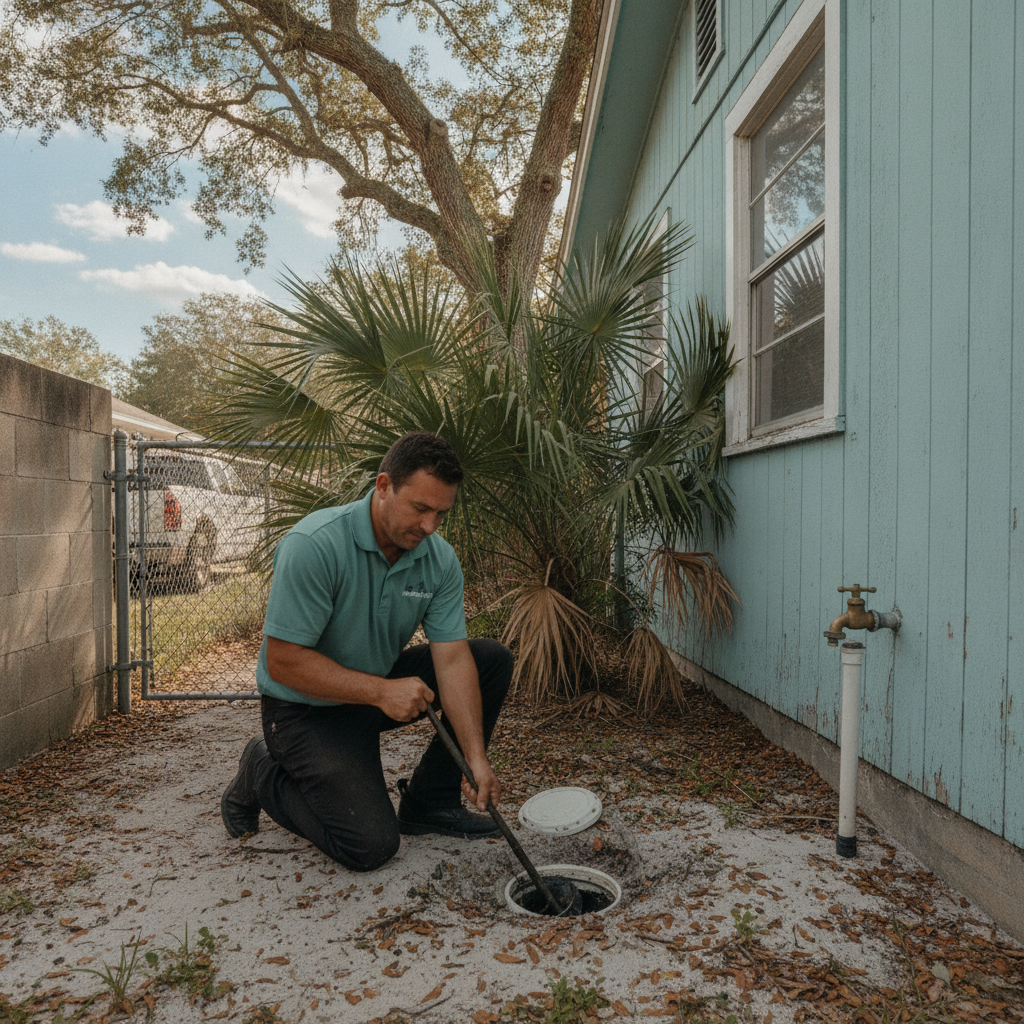
A 1950s Kenwood bungalow does not fail the way a Wesley Chapel spec house fails. Most St. Pete plumbing calls start at a hose bib that weeps after a few seasons of Gulf air, a kitchen that backs up on a lot too tight to trench easily, or a far bathroom that has gone weak because the original galvanized supply has narrowed from the inside. These houses sit on city water and city sewer, close together, and close to salt.
What St. Pete plumbing calls actually look like
The work is ordinary plumbing on Pinellas lots that leave almost no room to work. A licensed plumber in Old Northeast, Jungle Prada, or Crescent Heights is often standing in a side yard barely wide enough for a ladder. The cleanout may be there. It may be buried under pavers. It may never have been installed, because the bungalow predates the access the current code wants on new work.
Slow drains, a toilet that gurgles when the washing machine empties, and a wet patch near the property line are the usual openers. Those jobs start with drain cleaning when the pipe is still intact and packed with grease, wipes, or fine roots. They move to sewer line repair when a camera shows a crack, a belly, or a collapsed section under the slab or the front walk. Live oaks and old citrus stumps have had decades to find the lateral on these streets. The tree does not care how tight the lot is.
Water-side calls look different. Galvanized steel supply, still in many pre-1975 Pinellas bungalows, corrodes from the inside once the zinc is gone. Buildup narrows the interior until pressure drops, worst at the far bathroom or a second floor. Rusty water on the cold side points at those pipes. Rusty water on the hot side only usually means the tank itself is corroding, which is a water heater problem rather than a whole-house one. Galvanized fails in clusters. Patch one leak and the next joint is often a few months out, because the rest of the run is the same age and the same metal.
Outdoor fixtures fail early here. Salt air works on every exposed fitting, hose bib, and outdoor shower on St. Pete Beach, Pass-a-Grille, and the mainland streets that catch bay wind. A corroded sillcock that will not shut is not a small annoyance on a tight lot. It is a wet foundation and a climbing bill. We match you with a licensed plumber in St. Petersburg. The plumbers we send are licensed and insured. You can confirm a Florida plumbing contractor on the state license search.
Hurricane season, June through November, loads laterals that were already marginal. Storm debris sits on outdoor drains. A heavy rain after a week of tourists at a Snell Isle rental will show every grease line that was never cleared. A backup after a storm is still a plumbing diagnosis. It is not automatically a city main. The National Weather Service in Tampa Bay tracks the surge and rainfall that push those systems. The plumber still has to see whether the water is stopping in the house, in the lateral, or past the property line.
Salt air, tight lots, and pre-1975 bungalows
Salt air, a tight Pinellas lot, and a bungalow built before 1975 stack three problems on the same house. Chlorides in moist Gulf air sit on wet metal. A hose bib on painted wood siding in Gulfport or along Beach Drive stays damp after every evening breeze. The original steel weeps, then seizes, then fails open. Brass holds up better in that air, which is why the salt-air drain and fixture pattern in Largo shows up on St. Pete’s waterfront streets too. The mechanism is the same. The lots are often tighter here.
Tight lots change the repair path. There is no wide side yard to open a long trench. A driveway, a neighbor’s fence, and a slab patio often sit on top of the only run to the street. That is why a camera goes in before anyone talks about digging. A buried lateral is not visible from the yard. A Florida home inspection is a limited look at readily accessible plumbing, so a purchase inspection can miss the line under the walk. The camera is how the plumber sees cracks, roots, and bellies without guessing.
Pre-1975 bungalows carry the materials of that era. Cast iron on the drain side. Galvanized, and sometimes aging copper, on the supply side. Both have been in the ground or in the walls longer than their useful life on this coast. Tampa Bay water runs 11 to 17 grains of hardness, depending on season and source, so scale crusts shower heads and faucet cartridges on top of the corrosion. A Brandon rental shows that scale after a year. A St. Pete bungalow shows it on fixtures that have been in the same wall since the 1960s.
Access decides labor. Removing galvanized from a stucco bungalow with plaster walls is slower than opening a 1990s Valrico ranch. The plumber is fishing old pipe through small cavities, not walking a wide attic. Outdoor work has the same squeeze. A water heater in a carport or an exterior closet takes salt and humidity on the tank jacket, the T&P discharge, and every steel fitting. Indoor closets stay drier. A lot of these houses never had an indoor closet.
The city is dense in a way Pasco is not. Downtown, Old Northeast, and Kenwood put houses on top of each other. A sewer repair that would be a straight trench in Lutz becomes a conversation about the driveway, the live oak, and whether a section can be lined or replaced from a cleanout. None of that is a reason to wait. It is the reason the first visit is a diagnosis, not a guess from the street.
City water and sewer versus a Pasco well lot
St. Petersburg sits on city water and city sewer. A Land O’ Lakes, Odessa, or Wesley Chapel lot often does not. That split decides what actually fails, and who is allowed to touch it.
On a St. Pete bungalow the water arrives at a meter near the curb. The house plumbing starts on the customer side of that meter. Hardness and disinfectant are the city’s problem until the water crosses that point. After that, galvanized, copper, a tired pressure-reducing valve, and a scaled heater are the house. Most Tampa Bay utilities deliver somewhere around 45 to 60 psi at the meter under normal use. Florida’s plumbing code requires a pressure-reducing valve inside the building when static pressure exceeds 80 psi. Hose bibs and outside hydrants are not required to sit behind that valve. A bungalow with a slamming washer and a noisy heater is worth a gauge reading at a hose bib, not a guess.
Waste leaves through a private lateral to the city sewer. Roots, belly sags, and old cast iron are the failure modes. There is no drain field to saturate in an August storm. When the toilet gurgles, the plumber is looking at the house drains and the lateral, then at whether the city main is involved. That is a different afternoon than a Pasco septic backup after the same rain.
On a Pasco well-and-septic lot the water comes from a private well and a pressure tank. The waste goes to a tank and a drain field in sandy soil with a high water table. Heavy summer rain saturates that field, so a tank that was fine in March backs up in August. Pinellas Park can sit through the same storm on city sewer and never see it. Well pump and pressure-tank work is plumbing scope above ground. Anything on the onsite sewage system is a different credential. Florida’s rule reaches anyone who advertises septic pumping, repair, or abandonment, so we do not hold this brand out as a septic contractor. If a Pasco home needs that work, we get a licensed and registered septic contractor out. The Florida Department of Environmental Protection’s onsite sewage program is the state authority. County health departments still permit and inspect.
| What fails | St. Pete bungalow on city lines | Pasco well-and-septic lot |
|---|---|---|
| Water | City water at the meter, then old galvanized or copper in the house | Private well, pressure tank, and the pump above grade |
| Waste | Private lateral to city sewer, often under a tight front yard | Tank and drain field in sand, sensitive to summer rain |
| Outdoor metal | Salt air on hose bibs, outdoor showers, and exposed heaters | Less salt, more well-head and irrigation hardware |
| After a storm | Debris in drains, a loaded lateral, surge on low lots | A saturated field that will not accept water until it dries |
Hyde Park and Seminole Heights share the old housing stock. They do not share the salt. East Hillsborough shares slab-on-grade subdivisions and polybutylene from the late 1970s through the mid-1990s. That is not this bungalow. If the house is in St. Pete, start with salt, the lateral, and the original metal. If the house is in Wimauma, start with the well and the field.
How this differs from the cast iron failure story
The cast iron failure pattern under St. Petersburg bungalows already owns the drain-line mode. That post is the scale, the rusted-through hub, the camera that shows a channel in the invert, and the choice between a section repair and a full replacement. This page is the rest of the house around that pipe.
Cast iron is one reason a 1950s bungalow backs up. It is not the only reason. A grease-packed kitchen line will mimic a failing main until someone opens a cleanout. A missing cap on a private lateral lets debris and roots in. A hose bib that has been dripping into the slab edge for a season will look like a sewer problem from the yard. Older Tampa sewer laterals fail for some of the same age reasons. St. Pete adds salt on the fixtures and almost no room to dig.
A camera inspection is how those stories get sorted. The site publishes that work in a band that varies by whether the scope is bundled into other work or bought standalone. The point of the camera is the picture, not the invoice. If the iron is still round and the stoppage is grease, cleaning is the job. If the iron has lost its floor, cleaning is a pause before the line fails again.
Do not treat every slow tub in Old Northeast as a full sewer replacement. Do not treat every weeping hose bib as a repipe. The bungalow will eventually need both conversations if the metal is original. The first visit still has to name the part that is failing this week. That is the difference between this city page and the cast iron explainer. One tells you what the buried drain does when it dies. This one tells you why the same block also eats outdoor fittings, starves the back bathroom, and turns a hurricane week into a backup week.
Do you cover St. Pete Beach and the mainland bungalows
Yes. We cover St. Petersburg, the Gulf beaches, and the rest of Pinellas, plus Hillsborough and Pasco. Downtown, Old Northeast, Kenwood, Jungle Prada, Gulfport, St. Pete Beach, and Pass-a-Grille are all in that map. The plumbers we send are licensed and insured. A beach cottage and a Kenwood bungalow share salt and age. They do not share the same access, so the quote still comes after someone sees the lot.
What should I expect on a first visit for a St. Pete bungalow
A licensed plumber looks at the symptom, then at the materials. A slow main gets a cleanout and, when the stoppage will not clear, a camera. A rusty tap gets a hot-versus-cold test so the tank and the supply are not confused. A weeping outdoor fitting gets a look at the valve, the vacuum breaker, and the pipe in the wall behind it. Hidden leaks that need equipment sit on leak detection, often applied toward the repair. Nobody should open a slab or cut a sewer from the street on a hunch.
When to call us
Call when a drain will not recover, water is showing in the yard, an outdoor fixture will not shut, or pressure has dropped in one part of a pre-1975 bungalow. That work belongs to a licensed plumber, especially on a tight St. Pete lot where the next wrong cut is a neighbor’s fence or a live oak root. Call us at (813) 590-0625. We’ll match you with a licensed local plumber who works these Pinellas houses.