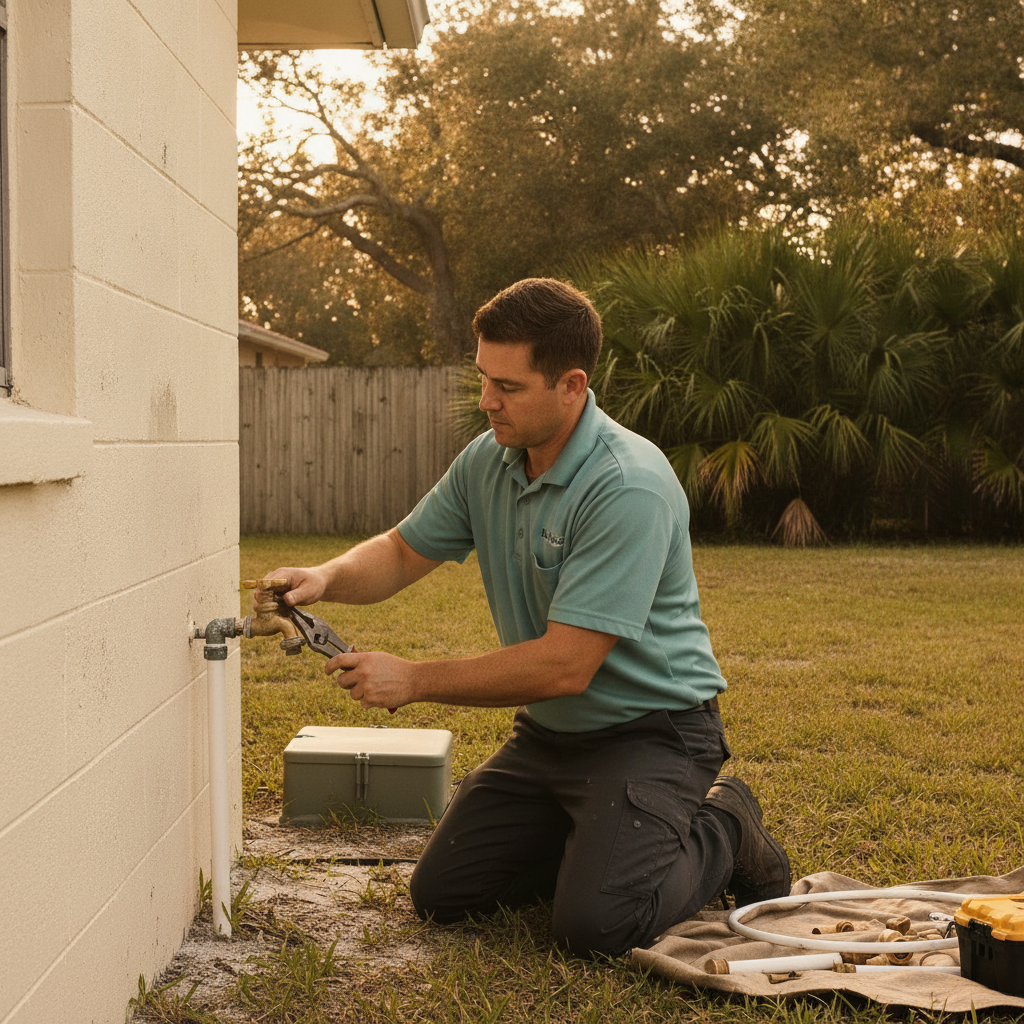
A white crust on the hose bib, a shower that fades after two minutes, an angle stop that weeps behind the toilet: that is the Palm Harbor call. Homeowners looking for palm harbor plumbers are almost always on Pinellas city water and sewer, not a Pasco well. We match you with a licensed plumber who already works this stretch of North Pinellas. The job is the scale, the salt on the west edge, and the original fittings in a 1980s ranch.
What Palm Harbor plumbers get called for
The typical Palm Harbor house is a block ranch or two-story from the late 1970s through the 1990s, on a cul-de-sac off Tampa Road, McMullen Booth, or U.S. 19. City water comes in at the meter in the front grass. City sewer leaves at the back or the side. There is no tank in the yard and no pump house. What fails is the stuff that city water and Gulf air wear out.
Cartridge faucets are first. Hard water leaves a mineral film on the ceramic discs until the handle gets stiff, then the spout drips. The same crust forms on shower valves, dishwasher inlets, and the dip tube and sediment layer inside a tank water heater. A heater that pops, takes forever to recover, or runs out of hot water on a school morning is usually scaled, not mysterious. The licensed water heater repair the plumbers we send do starts with that tank, not a guess.
Kitchen and bath drains slow the same way. Soap, toothpaste, and grease bind to mineral film and hang on the pipe wall. A cable through an accessible cleanout often restores flow. Recurring backups on the same line are a different conversation, and that is when drain cleaning with a camera tells you whether the clog is debris or a damaged pipe.
Outdoor fittings take a beating on the Crystal Beach and Ozona side, where salt air sits on every hose bib. Inland, in Lansbrook or Highland Lakes, the hose bib still fails, just slower: the stem seizes, the vacuum breaker cracks, and the first cold front of hurricane season is when someone notices it will not shut.
Then there is the after-hours scene. A Gulf storm, per the National Weather Service Tampa Bay forecast desk, drives rain sideways against the west wall. A supply line or an old angle stop lets go in a hall bath. Water hits the vinyl. The move is not to hunt for a wrench in the dark. Shut the water at the house valve, then call us so we can match you with a licensed plumber. If you need help finding that valve, read how to shut off the water in an emergency before the next storm week.
We cover Palm Harbor with the rest of Hillsborough, Pinellas, and Pasco. The plumbers we send are licensed and insured. We do not own the truck or the parts bin. We get you the person who does.
North Pinellas stock on city water and sewer
Palm Harbor sits in that North Pinellas band with Dunedin and Tarpon Springs: older suburban housing on municipal water and municipal sewer. That is the whole local fact, and it decides the plumbing. You are not flushing a drain field in August the way a Land O’ Lakes lot does. You are not pulling a well pump after a lightning cell over Pasco. You are living with whatever Pinellas County Utilities delivers to the meter, plus whatever the original builder put in the walls.
Pinellas County Utilities’ 2024 water report, using 2023 samples the report still calls representative, lists total hardness from 168 to 252 ppm. The report itself converts that to 9.8 to 14.7 grains. Across Tampa Bay the site already treats hardness as running about 11 to 17 grains, depending on season and source. Either way, this is not soft water. Calcium and magnesium plate the inside of a tank, a cartridge, and a 40-year-old galvanized nipple until flow drops at the far bathroom.
Pinellas also switches from chloramine to plain chlorine twice a year on purpose. Homeowners notice smell and taste for a stretch. That conversion is not a discoloration event. Brown water still points at sediment in the main, a flushing crew, a corroding heater on the hot side, or aging galvanized on the house side.
Inside the house, the stock is mixed. Some ranches still have original galvanized supply in spots, the kind that corrodes from the inside and narrows until the upstairs bath feels weak. Some have copper that is old enough for pitting. A late-1970s-to-mid-1990s floor plan can still hide original plastic supply that has not aged well. Slab-on-grade is common, so a leak under the house does not announce itself with a wet ceiling. It shows up as a warm floor, a hiss, or a bill that jumped.
On the waste side you are on city sewer. A cleanout near the house and, on many lots, a second one toward the property line is how a plumber tells house trouble from a utility-side backup. Roots, grease, and scale still clog a suburban lateral. They just do not involve a drain field.
For a licensed plumber already working this city, start on our Palm Harbor page and tell us whether the problem is hot water, a drain, a hose bib, or a leak you can hear.
Scale, salt air, and aging angle stops
Scale is the quiet one. It does not flood the hall. It ruins the parts you touch every day. A cartridge that was smooth in March gets gritty by the next school year. The shower loses temperature control because the valve can no longer mix cleanly. The dishwasher leaves a white film on glasses. Inside the tank, sediment piles on the bottom, the burner or elements work harder, and the anode rod sacrifices itself against Tampa Bay minerals. That chemistry, and what to do about the tank, is the subject of Tampa hard water and your water heater. The short version for a Palm Harbor ranch: the heater is doing extra work the day it is installed.
Faucet repair in Tampa Bay is the same story at the sink. A drip after a fresh cartridge often means scale is still in the valve body. Replacing the cartridge without addressing the water leaves you back at the same drip. A licensed plumber can pull the valve, see the crust, and tell you whether a part swap is enough or the body is pitted.
Salt air is the other half, and it is geographic even inside one city. Crystal Beach and Ozona sit closer to the Gulf. Hose bibs, outdoor showers, and pool equipment see that air every day. Cheap chrome blisters. Threads freeze. The little vacuum breaker on the spigot cracks and starts to weep. Florida’s residential code requires sillcocks, hose bibs, wall hydrants, and other hose openings to be protected by a vacuum breaker or a listed backflow device, with narrow exceptions that do not cover a garden hose. That is why a plumber replaces a failed bib with a brass, protected fitting instead of a bargain stem from a bin. Inland Palm Harbor gets less salt and the same hard water, so the bib still fails, just more from minerals and UV than from spray.
Angle stops are the third failure, and they hide. Those are the small shutoffs under the sink and behind the toilet. Scale seizes the stem. The handle will not turn, or it turns and the packing weeps. The first time you need that valve, during a supply leak in a September storm, it either will not close or it snaps in your hand. That is why a licensed plumber often replaces the stops while already in the cabinet, and why knowing the house shutoff still matters. The angle stop is a convenience. The house valve is the one that actually stops the flood.
None of this needs a well diagnosis. It needs someone who has seen Pinellas city water chew through the same three parts on the same vintage of house.
How Palm Harbor differs from Dunedin and from Pasco wells
Palm Harbor and Dunedin share a water source type and a sewer type. The difference is the lot and the age mix. Dunedin packs tighter toward the harbor, with more of the older cottage and bungalow pattern you also see as you drop south along the Gulf. Cast iron drain lines show up more often in that older pocket. Palm Harbor spreads out: golf-course streets around Innisbrook, deed-restricted loops in Lansbrook and Highland Lakes, and a west edge at Crystal Beach that behaves more like a coastal block than a Pasco subdivision. Same city water. Different access, different salt load, different original pipe.
Pasco is the real contrast. Land O’ Lakes, Odessa, and Wesley Chapel are where well and septic actually live, on sandy soil with a high water table. A tank that was fine in March can back up after an August afternoon storm saturates the field. Lightning takes out pumps. None of that is the Palm Harbor default. If you did cross into a well or septic pocket near Lake Tarpon, that is a different license picture: the septic pros we send are licensed and registered, and we line you up with them rather than advertising tank work ourselves. For a typical house west of East Lake, you can skip that file.
| What you are comparing | Palm Harbor | Dunedin | Pasco suburbs (Land O’ Lakes, Odessa) |
|---|---|---|---|
| Water | Pinellas city water at the meter | Pinellas city water at the meter | Private well is common |
| Waste | City sewer | City sewer | Septic and drain field are common |
| Housing pattern | Older suburban ranches and 1980s–1990s subdivisions | Older, tighter stock toward the harbor | Mix of acreage and newer subdivisions |
| What usually fails | Scale on cartridges and heaters, seized angle stops, salt-worn hose bibs on the west edge | Similar city-water scale, plus more aging drain lines in the older pocket | Well pumps, pressure tanks, and drain fields after summer rain |
| Who you need | A licensed plumber for house plumbing | A licensed plumber for house plumbing | A licensed plumber, and a licensed and registered septic contractor when the tank or field is the issue |
If you are comparing two North Pinellas cities and the copy could swap the names, it is the wrong copy. Palm Harbor’s tell is the suburban city-water ranch with a scaled heater and a hose bib that has seen just enough Gulf air to freeze. Dunedin’s tell is the older, tighter lot. Pasco’s tell is the well cap and the tank lid in the grass.
You can confirm a plumbing contractor’s license on the state’s MyFloridaLicense search before anyone opens a wall. That is a better check than an hourly rumor, and it is the check choosing a licensed plumber in Tampa walks through.
Are most Palm Harbor homes on well water or city water?
Most Palm Harbor houses sit on Pinellas city water and city sewer. That is the North Pinellas pattern, the same one you get in Dunedin and Tarpon Springs. Well and septic belong to Pasco and to pockets around Lake Tarpon, not to the typical ranch off Tampa Road. If your bill comes from Pinellas County Utilities and you have a meter box in the front yard, you are on city water. Scale, not a pump, is then the thing wearing out the heater and the faucets.
What should I do if a supply line leaks during a Gulf storm?
Shut the water off at the house valve, usually on the side of the house in line with the outdoor faucet. If that valve is seized, the meter is the last resort and it is easy to damage, so treat it as a last move. Stay off electrical switches if water is near them. Then call us and we will match you with a licensed plumber. An emergency plumber in Palm Harbor still starts with a dry floor and a closed valve, not with a flashlight in a live panel.
When to call us
Call when a faucet will not stop dripping, the heater cannot keep up, a hose bib weeps, an angle stop will not close, or a drain keeps slowing after you have already cleared the trap. Those are licensed plumber jobs on Palm Harbor city water, and they get worse in storm season. Call us at (813) 590-0625. We will match you with a licensed local plumber who works this part of Pinellas.