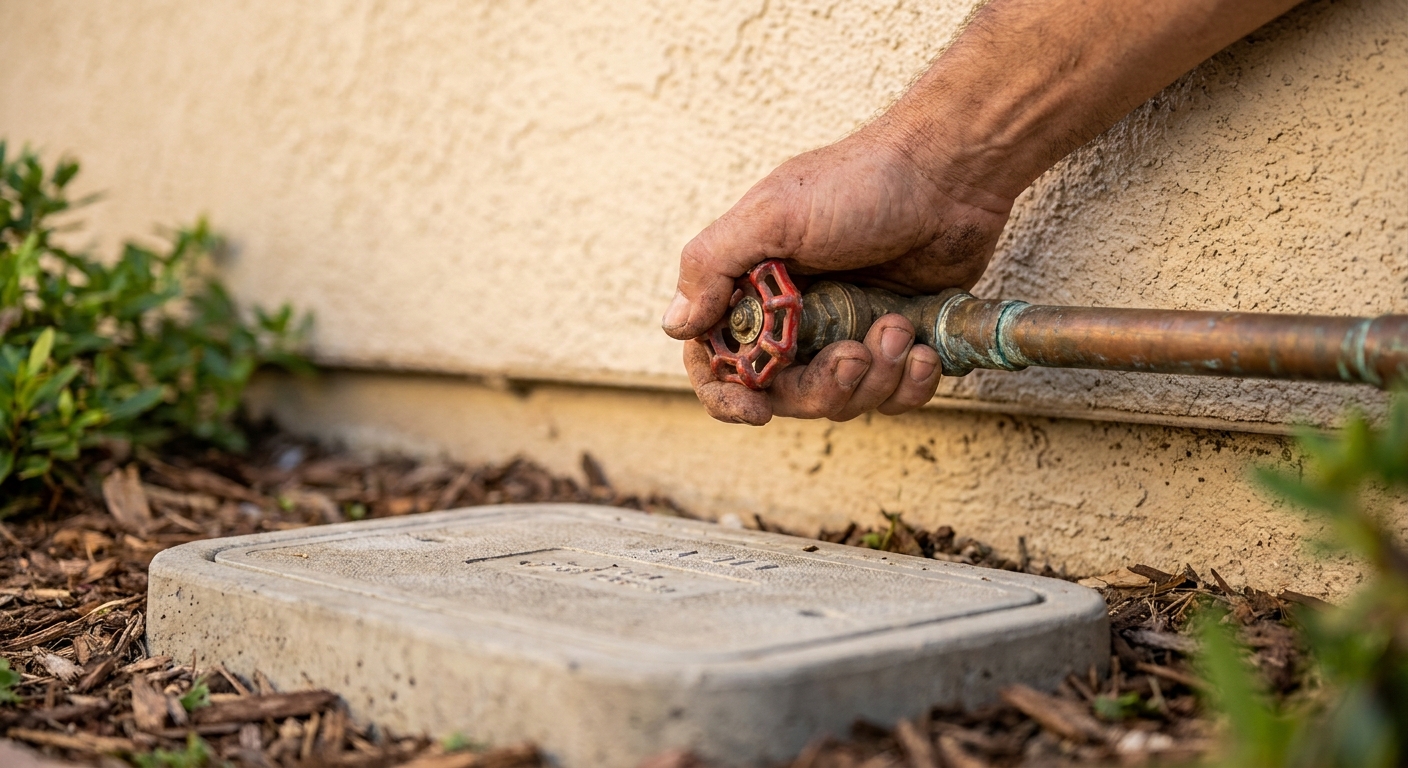
A burst pipe doesn’t wait for a convenient time. When water is actively coming into your house, the single most important thing you can do before anyone picks up a phone is get the water shut off. Every minute of delay is more water damage, more drywall, more flooring, more mold risk down the road. This is the guide we wish every Tampa Bay homeowner had taped inside a kitchen cabinet.
Find your shutoffs before you need them
Don’t wait for an emergency to figure out where your shutoffs are. Walk your house today and locate three things: the main shutoff valve, the fixture shutoffs under sinks and toilets, and the water heater shutoff. In a lot of homes built in the polybutylene era around Carrollwood, Town ‘n’ Country, and New Tampa, these valves haven’t been touched in years and may be stiff or even seized. Test them now, gently, so you’re not fighting a frozen valve while water is spreading across your floor.
The main shutoff valve
Your main shutoff is the fastest way to stop water to the entire house. In most Tampa Bay homes on slab foundations, it’s located in one of a few common spots: near the water meter at the edge of your property line, in a garage or utility closet, or occasionally in an outdoor box near the front hose bib. Homes in Hillsborough and Pinellas built before the 1990s sometimes have the main valve buried under landscaping that’s grown up around it over the decades, especially in older neighborhoods like Seminole Heights, Hyde Park, and St. Petersburg’s Old Northeast.
To shut it off, turn the valve clockwise (righty-tighty) until it stops. Gate valves need several full turns. Ball valves, which are more common in newer installs, only need a quarter turn to fully close. If the handle won’t budge, don’t force it hard enough to snap the stem. Use a wrench for extra leverage or call us immediately if it’s frozen shut.
The water meter shutoff
If you can’t find or access your main house valve, or it’s broken, the water meter itself has a shutoff. It’s usually near the curb or sidewalk under a metal or plastic lid marked “water.” Inside, you’ll see a valve, sometimes requiring a meter key or a flathead screwdriver to turn. This is the utility’s line, so treat it as a true last resort, but it will stop water from entering your property entirely.
While the lid is off, the meter is also the tool that tells you whether you’re losing water underground. If the register climbs with every fixture shut off, the leak is likely in the buried line between the meter and the house, which is the homeowner’s line to repair.
Shutting off a single fixture
Most of the time, you don’t need to kill water to the whole house. A toilet overflowing, a supply line under a bathroom sink failing, or a washing machine hose bursting can usually be handled at the fixture level.
Toilets: Look for a small oval valve on the wall or floor behind the toilet, on the water line running up to the tank. Turn it clockwise until snug.
Sinks: Under every sink there should be two shutoff valves, one for hot and one for cold, right where the supply lines meet the wall. Turn both clockwise.
Washing machines: Two valves, usually mounted on the wall behind the machine, control hot and cold supply. These get overlooked constantly and are a common source of slow, hidden leaks in laundry closets in condo units around Clearwater Beach and St. Pete Beach.
Water heater: There’s a shutoff valve on the cold water inlet line at the top of the tank, or on the supply line for a tankless unit. Turning this off stops water from continuing to feed the tank if it’s leaking, and buys time until water heater repair arrives. Shut off the unit’s power or gas before its water, and see how to find where a water heater is leaking from for the full sequence.
What to do after the water’s off
Once water is stopped, open a low faucet somewhere in the house, like an outdoor spigot or a tub, to relieve pressure in the lines and drain out what’s left. Then assess the damage. If you smell gas near a water heater or see water near any electrical outlet or panel, don’t go near it, get everyone out, and call us right away.
Take photos of standing water and damaged materials before you start any cleanup for insurance purposes. Move furniture and rugs off wet flooring immediately. Wet drywall and baseboards should come out sooner rather than later in Florida’s humidity, because mold takes hold fast here, often within 24 to 48 hours in an un-air-conditioned or poorly ventilated space.
Why this matters more in Tampa Bay specifically
Two local factors make emergency shutoffs more urgent here than in a lot of the country. First, our humidity means water damage and mold spread faster than they would in a drier climate, so speed matters even more. Second, a lot of our housing stock, especially homes built between 1978 and 1995, has polybutylene piping that’s now decades past its intended lifespan and prone to sudden failures without warning. If your home falls in that window and you haven’t had a plumber assess your pipe material for a possible repipe, that’s worth doing before you’re standing in an inch of water at 11pm on a Saturday.
Save our number now
The best time to save an emergency plumber’s number is before you need one. Program (813) 590-0625 into your phone right now. When water’s coming through your ceiling or pooling around your water heater, you won’t want to be searching for a number, you’ll want to be shutting off a valve and calling us in the same sixty seconds. We run emergency service across Hillsborough, Pinellas, and Pasco counties, and we’d rather talk you through a shutoff over the phone at 2am than have you wait until morning.
A quick note on outdoor spigots and irrigation
Don’t forget your irrigation system has its own backflow preventer and shutoff, usually near where the line leaves the house. If a sprinkler line or outdoor spigot is the source of your leak, you likely don’t need to touch the main house valve at all, just isolate that one line and you’ll keep water running everywhere else in the house.