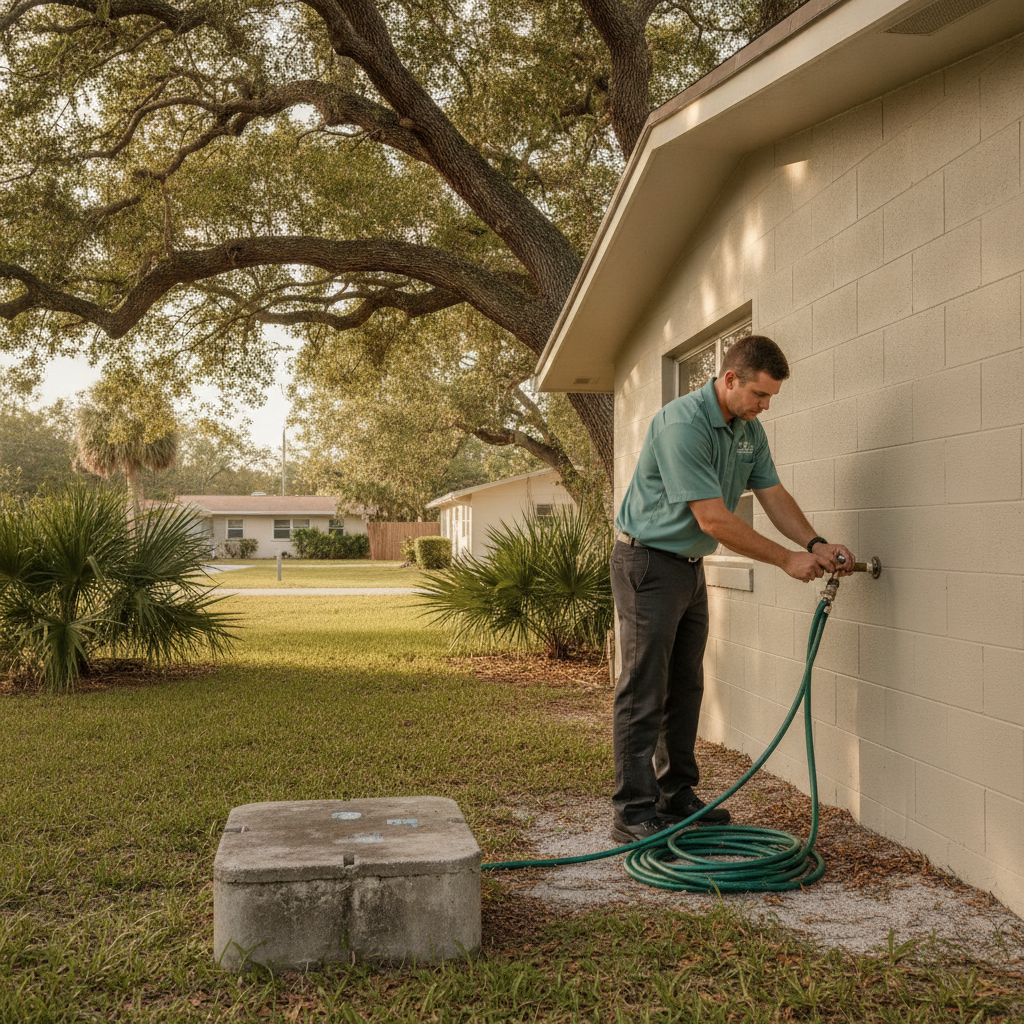
A hose bib lets go after dark on a 1960s block ranch under live oaks, and the city meter in the grass keeps turning. That is how most Temple Terrace plumbing calls start: city water, city sewer, and parts that have been on the same lot since the house went up. Searches for 24 hour Temple Terrace plumbers spike on those nights because the leak will not wait until morning. We answer the line and match you with a licensed plumber.
What Temple Terrace plumbing jobs usually are
The work on these lots clusters around three systems, not a long menu of one-off gadgets. Supply lines, drains, and the water heater take almost every call.
On the supply side, original galvanized steel is still in play in the older core and the historic district. Galvanized corrodes from the inside out. Scale and rust narrow the bore until the far bathroom loses pressure, then a thread at a hose bib or under a sink opens up. Once one fitting weeps, the next one is usually close. Copper that went in later can pit. PEX and newer copper show up where a prior owner already cut out a bad run.
On the drain side, the house is on city sewer, so the problem is the private lateral from the foundation toward the property line, plus the kitchen and bath stacks that feed it. Live oaks lift sidewalks and find joints. Grease from decades of kitchen use coats the upper line. Hair and soap scum take the baths. A toilet that gurgles when the washing machine drains is the lateral talking, not a flapper.
The water heater sits in the garage or a utility closet and lives on the same hard city water as the rest of the house. Sediment drops to the bottom of a tank. Elements and dip tubes wear. A tank that pops and rumbles is usually scale, not a mystery. Water heater repair on these lots is often a part, sometimes a tank, and the choice depends on the tank’s condition, not a sales script. When that choice is on the table, repair versus replace is the honest fork.
Residential plumbing here is the piping, fixtures, water heater, and sewer lateral that serve a house, not the city main in the street. Licensed plumbing contractors install and repair those systems. A handyman can swap a fill valve. Cutting pipe, opening a lateral, or touching a gas water heater belongs with a licensed plumber. You can confirm a Florida plumbing license at the state licensee search.
1950s to 1970s lots on city water and sewer
Temple Terrace is inner Hillsborough, not a well-and-septic belt and not a 2000s HOA slab farm. The housing that defines the city went up from the 1950s through the 1970s: one-story block ranches, bigger lots than South Tampa, live oaks that have had seventy years to grow.
Those houses were tied to municipal water and municipal sewer from the start. There is no tank in the backyard to pump. There is a meter in the front grass and a lateral in the yard. That split matters when something backs up. City crews work the public main. Everything from the house to the right-of-way is the homeowner’s side, and that is the run the plumbers we send actually open.
The original supply is often galvanized steel, well past the 40 to 50 year life that material was built for. Interior rust narrows the pipe. Tampa Bay water runs 11 to 17 grains of hardness, so minerals plate the inside of whatever metal is left. Pressure falls first at the far fixture or the upstairs bath if the house has one. Outdoor hose bibs fail early because they sit in weather and get wrenched every time someone waters.
The original drain package is older too. Cleanouts, if they exist, may be buried in oak roots or under a patio someone poured in the 1990s. An older house that predates current cleanout rules often has no usable access at the property line. The plumber then works from a roof vent, a pulled toilet, or a cleanout that has to be added before the line can be seen.
Yards are the other half of the lot. A live oak on a 1960s lateral is not a maybe. Roots follow moisture. They enter at a joint, then they thicken. The line still “works” until a heavy laundry day or a holiday weekend, then it does not. That is a Temple Terrace pattern, not a New Tampa one.
Scale, slow drains, and trees on older laterals
Hard water is the quiet job. It does not flood a room. It crusts a shower head in a year, etches a glass shower door, and loads the water heater with sediment. Scale on a heating element makes the tank work harder and run out of hot water sooner. The site’s own hard-water write-up on what Tampa water does to a heater is the same chemistry on these lots. A softener or a filter can slow that down. It does not fix a lateral the oaks already found.
Slow drains are the loud job. One bathroom sink is usually hair and toothpaste in the trap. Two baths and a kitchen at once is the main. Recurring backups after a cable cleaning mean the line is not just dirty. Roots, a belly, or a broken joint will refill the same spot. Camera work before another clearing pass is how you stop guessing. Hydro-jetting a cracked pipe can open the crack. Seeing the line first is the difference.
Trees make the lateral the long job. The private sewer run on a 1950s to 1970s Temple Terrace lot is old enough for joints to shift and for oak roots to occupy them. Symptoms stack: a floor drain that smells after rain, a toilet that bubbles when the shower runs, grass that stays greener over one stripe of yard. Sewer line problems in older Tampa stock follow the same pattern along the river and the inner neighborhoods. Temple Terrace is that stock with bigger trees and more yard for the roots to use.
Drain cleaning through an accessible cleanout clears grease, soap, and roots that have not yet broken the pipe. A section that is offset or collapsed is repair, not another snake. The plumber we send should say which one you are looking at before anyone cuts a trench.
Storm weeks add volume. June through November, afternoon rain loads every lateral in the city at once. A line that was slow in March can back up in August because the public main is high and your private run is already narrow. That is timing, not a new kind of plumbing.
How Temple Terrace differs from New Tampa and from Brandon slabs
Temple Terrace is not New Tampa with a different zip code, and it is not Brandon with oaks. The pipe, the lot, and the failure mode change.
New Tampa is 1990s-to-2000s subdivision stock: slab-on-grade, PVC drains, PEX or copper supply, HOA rules about what you can open in the yard. Failures there skew toward water heaters, fixture valves, and the occasional slab leak on a newer line. The trees are younger. The laterals are younger. A Temple Terrace plumber who treats a 1964 ranch like a 2004 New Tampa house will miss the galvanized and the oak.
Brandon and the east Hillsborough belt are the polybutylene and slab story. Late-1970s to mid-1990s subdivisions there still carry poly-b supply, which fails at fittings and in the slab. The common plumbing problems in Brandon are that material and that foundation, not seventy-year-old laterals under live oaks. A Temple Terrace historic-district house can still have galvanized in the walls. A Valrico house from 1988 is a different repair.
| What differs | Temple Terrace | New Tampa | Brandon and east Hillsborough |
|---|---|---|---|
| Typical lot | 1950s to 1970s ranch under live oaks, city water and sewer | 1990s to 2000s HOA subdivision, newer laterals | 1980s to 2000s slab-on-grade subdivision |
| Supply you still find | Galvanized in the older core, later copper or PEX patches | PEX or copper from the original build | Polybutylene in the late-1970s to mid-1990s belt, then later materials |
| Drain and sewer trouble | Oak roots on an older private lateral, missing or buried cleanouts | Newer PVC, fewer root calls, more fixture clogs | Slab geometry and, on older poly-b streets, supply leaks under the slab |
| Water heater stress | Hard-water scale in a tank that has been on city water for decades | Same hard water, newer tanks and often better access | Same hard water, plus slab-adjacent equipment in garage utility niches |
A service call costs what the access and the failure demand, not a flat city rate. A popped supply line at a hose bib is a short visit if the shutoff works. A lateral under oaks, with no cleanout, is a longer one because the plumber has to see the line before quoting a repair. After-hours work costs more because it pulls a licensed plumber off the daytime board. Ask for the mechanism: what has to be opened, what has to be seen, and what gets put back. That is the number. Anyone quoting a house they have not looked at is guessing.
Can a handyman fix a leaking toilet in Temple Terrace?
A leaking fill valve or a worn flapper is a fixture part, and a careful homeowner can change those. A leaking toilet that rocks, stains the floor, or keeps wetting the ceiling below is a wax ring, a flange, or a supply stop, and that is licensed plumber work. If the leak is at the water line or in the floor, stop at the shutoff and call. Guessing at a flange on a 1960s closet bend is how a small leak becomes a floor repair.
Who should I call for an after-hours supply leak?
Shut the water off at the house valve, usually on the side of the house, then call a licensed plumber. We answer the line at (813) 590-0625 and match you with someone who can isolate the leak. Do not open a slab or cut a main yourself. A running hose bib or a burst under-sink supply is a scene, not a DIY.
What does a Temple Terrace plumber actually work on?
Pipes, fixtures, water heaters, and the private sewer lateral on city lots. The city owns the main in the street. You own the run to the house. The plumbers we send are licensed and insured for that house-side work. They do not replace the municipal main, and they do not need a septic registration for ordinary Temple Terrace sewer laterals, because these lots are on city sewer.
When to call us
Call when a supply line is open, a heater is leaking, more than one drain is slow, or a toilet gurgles when another fixture runs. Those are licensed plumber jobs on 1950s-to-1970s Temple Terrace lots, and they get worse if they wait for the next oak-root season. Call us at (813) 590-0625.