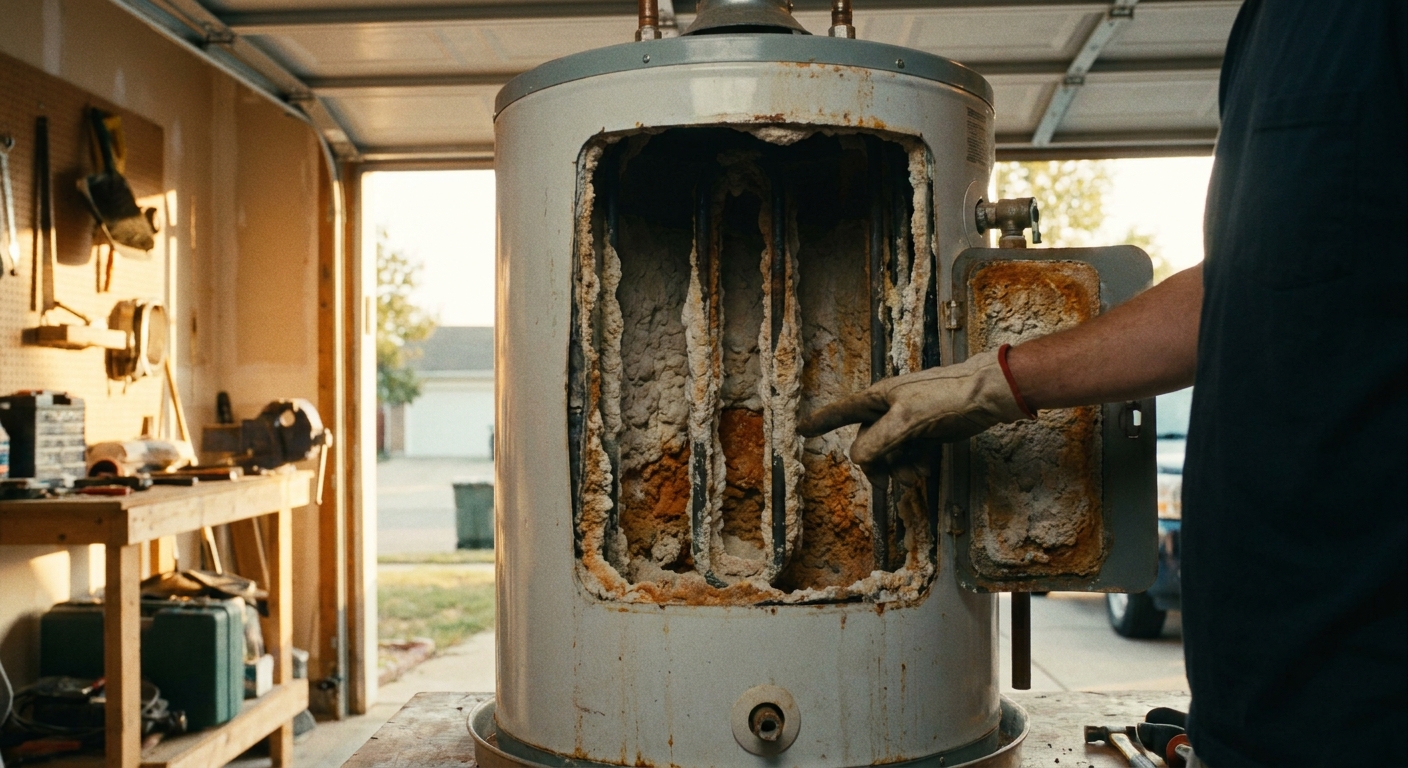
Most homeowners in Tampa Bay figure their water heater died of old age. Look closer and the real culprit is usually sitting in a layer of hardened scale at the bottom of the tank. Tampa’s water is hard, genuinely hard, and it’s quietly cutting years off water heaters all over Hillsborough and Pinellas counties.
Just how hard is Tampa’s water
Tampa municipal water typically tests around 11.7 grains per gallon, which already puts it in the “hard” category. During the dry season, especially in areas drawing more heavily on groundwater, that number climbs toward 17 to 18 grains per gallon. Anything above 10.5 grains is considered hard water, and above 15 is what utilities and plumbers call very hard.
If you’re on a private well, which is common in parts of Odessa, Thonotosassa, or the rural fringes of Pasco County, your numbers can run even higher, often loaded with dissolved iron and sulfur on top of the calcium and magnesium that make water hard in the first place.
What actually happens inside the tank
Every gallon of hot water that passes through your heater leaves behind a small amount of dissolved calcium and magnesium. When water heats up, those minerals come out of solution faster and settle as scale. Over months and years, that scale builds a layer at the bottom of the tank, right where the burner or heating element does its work.
That layer acts like insulation between the heat source and the water you actually want heated. The unit has to run longer and hotter to reach the same temperature, which burns more gas or electricity and puts extra stress on the burner assembly or heating elements. Eventually the scale gets thick enough that it starts to crack and flake, clogging drain valves and, in tankless units, clogging the narrow heat exchanger passages entirely.
The symptoms show up gradually
Homeowners usually notice three things first: rising utility bills that don’t match any change in usage, popping or rumbling noises coming from the tank as steam bubbles form and burst under the scale layer, and hot water that takes longer to arrive or runs out faster than it used to. By the time you notice reduced hot water volume, the tank has usually already lost meaningful capacity to sediment buildup.
Tankless water heaters, which have become popular in newer builds around Riverview and Wesley Chapel, are actually more vulnerable to hard water damage, not less. Their heat exchangers use narrow channels that scale up fast without regular flushing, and a scaled tankless unit can lose efficiency within a year or two if nobody’s maintaining it.
The lifespan difference is real
A standard tank water heater is rated for roughly 8 to 12 years under normal conditions. In Tampa’s hard water without any mitigation, we regularly see tanks fail in the 5 to 7 year range, sometimes sooner in homes running the hardest water during dry-season spikes. That’s a third to half the expected life, purely from mineral buildup nobody addressed.
What actually slows the damage
Annual flushing matters more here than in most parts of the country. Draining a few gallons from the tank’s bottom valve once a year clears loose sediment before it hardens into a solid layer. It’s a 20-30 minute job and it’s the single cheapest thing you can do to extend a heater’s life in this water. What a professional flush runs, and how often the manufacturers themselves ask for one, is covered in our guide to water heater flush cost in Tampa Bay.
A whole-house water softener addresses the problem at the source instead of just managing symptoms. A softener swaps out calcium and magnesium for sodium before the water ever reaches your heater, which means no scale forms in the first place. For a typical Tampa home, a properly sized softener runs somewhere in the $1,800 to $3,500 range installed, and homeowners with a softener in place routinely get the full rated lifespan out of a water heater instead of losing years to scale. Worth knowing before you shop: a whole-house carbon filter is a different device and won’t slow scale at all, which we lay out in water filter vs. water softener in a Tampa Bay home.
Anode rods are the other piece people skip. The anode rod is a sacrificial metal rod inside the tank designed to corrode instead of the tank itself. In hard water, that rod gets consumed faster because of the increased mineral and mineral-reaction activity. Checking and replacing the anode rod every two to three years, instead of the standard four to five, keeps tanks from developing internal corrosion on top of the scale problem.
Sizing for Tampa’s water when you replace
When we replace a water heater in a home without a softener, we size and spec differently than we would in a low-mineral market. That usually means recommending a unit with an easier-to-access anode rod and drain valve, since regular maintenance is non-negotiable here, and being upfront that a tankless unit needs a maintenance contract or a softener ahead of it to hit its advertised lifespan.
What we’d tell you if we were standing in your garage
If your water heater is popping, taking longer to deliver hot water, or is past the 6-year mark without ever being flushed, get it checked by a water heater repair pro before it fails on a weekend and floods a closet. A flush now is cheap. A tank that ruptures because scale ate through the bottom is not.
Call Tampa Plumbing Pro at (813) 590-0625. We’ll flush what’s salvageable, tell you honestly if it’s time to replace, and talk through whether a softener makes sense for your house.
What we look for on a service call
When we’re out flushing or inspecting a water heater in a hard-water home, we’re checking more than just the tank exterior. We pull the drain valve and see how much sediment comes out first, since a valve that’s already clogged with scale tells us the flush should have happened a year or two earlier. We check the anode rod condition if it’s accessible, because a rod that’s fully consumed means the tank itself is the next thing to corrode. And we listen for the specific popping pattern that tells us how thick the scale layer at the bottom has actually gotten, since that sound changes as the buildup grows.
Gas versus electric in hard water
Gas water heaters and electric water heaters both suffer from scale, but the failure points differ slightly. On a gas unit, scale insulates the bottom of the tank from the burner underneath, which means the burner has to run longer to reach temperature and the metal near the burner takes the most thermal stress. On an electric unit, the heating elements themselves sit inside the tank, submerged directly in the water, and scale builds up directly on the element surface, which is why electric heating elements in Tampa’s water often need replacement well before the tank itself fails. If you’re on electric and hearing a heater run longer than it used to for the same amount of hot water, a scaled element is usually the first thing worth checking.