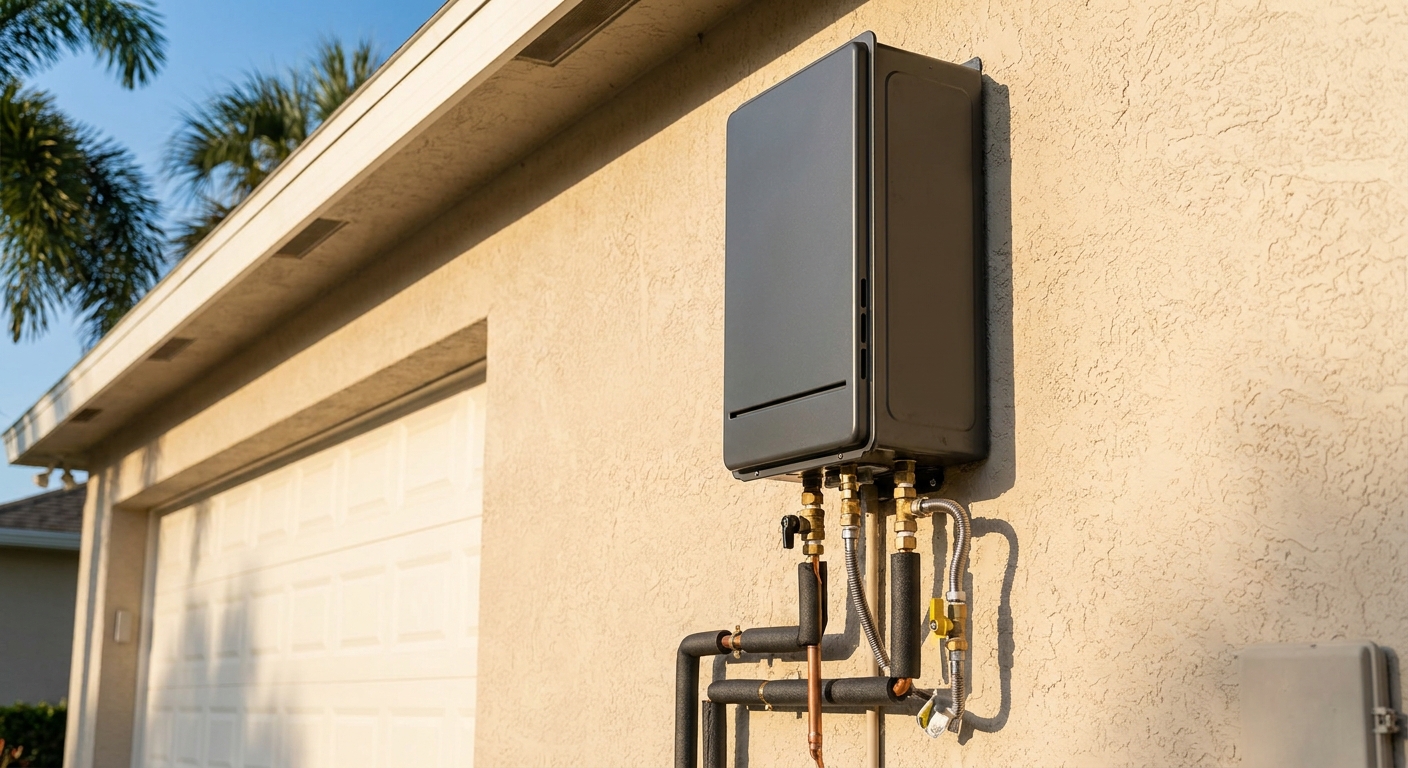
Florida’s climate actually makes tankless water heaters a better bet than they are in colder states. Our incoming groundwater already runs warm most of the year, so a tankless unit doesn’t have to work as hard to hit your target temperature. That said, tankless isn’t automatically the right call for every home in Tampa Bay, and our hard water changes the math in ways a lot of homeowners don’t find out about until after installation.
How tankless actually performs here
A traditional 40 or 50-gallon tank water heater keeps a set amount of hot water heated around the clock, whether you’re using it or not. A tankless unit heats water on demand, as it passes through the unit. In a South Tampa household with two teenagers running back-to-back showers, that means no more cold surprises halfway through the second shower. In a Sun City Center retiree home with lower daily hot water use, the energy savings show up more clearly on the utility bill.
Because groundwater in Hillsborough and Pinellas counties starts warmer than it would up north, Tampa’s tankless units often hit their target output faster and with less strain than the same unit installed in Ohio or Michigan. That’s a real advantage. It’s also part of why we install a lot of tankless systems in newer construction around Wesley Chapel, Riverview, and FishHawk, where builders are already spec’ing efficient systems.
The hard water problem nobody mentions upfront
Here’s the part that catches people off guard. Tampa Bay water measures around 11.7 grains per gallon on average, and in dry season or on deep wells it can climb to 17 or 18 gpg. That’s solidly in “very hard” territory. Hard water is rough on any water heater, but it’s especially rough on tankless units because of how they work. Water flows through a narrow heat exchanger, and every mineral grain in that water has a chance to build up scale on the exchanger walls.
Scale buildup in a tankless heat exchanger does two things. It reduces flow and heating efficiency over time, and it shortens the unit’s working life if nobody’s flushing it regularly. A tankless water heater that would last 15 to 20 years on soft water might only get 10 to 12 years here without maintenance. That’s still longer than most tank units, but it’s not the “install it and forget it forever” pitch some installers give.
The fix is straightforward: an annual descaling flush, and ideally a whole-home water softener ahead of the unit if you don’t already have one. In neighborhoods like Carrollwood, Town ‘n’ Country, and New Tampa, where polybutylene-era homes often need a repipe and a softener anyway, pairing a softener with a tankless install just makes sense from day one.
What it actually costs in Tampa Bay
A tankless install typically runs higher upfront than a tank swap. For a standard gas tankless unit sized for a 3 to 4 bedroom home, expect somewhere in the range of $3,500 to $6,500 installed, depending on whether we’re running new gas line, venting, or electrical to support it. A comparable tank replacement usually lands between $1,800 and $3,200.
The payback comes from two places: lower monthly energy costs (tankless units only heat what you use, typically saving 20 to 30% on water heating costs for an average household) and a longer service life if it’s maintained. For a family that’s actually running out of hot water regularly, or a household planning to stay in the home for 10-plus years, the math works in tankless’s favor. For a smaller household in a home you’re planning to sell in three years, a straightforward tank replacement is often the more sensible spend.
Gas versus electric tankless in Tampa Bay homes
Most of the older housing stock in South Tampa, Seminole Heights, and St. Petersburg’s Old Northeast was built with gas lines already in place, which makes gas tankless the easier retrofit. Newer construction in Wesley Chapel, Trinity, and the South Shore communities often runs all-electric, and electric tankless units are a real option there, though they typically require a dedicated high-amp circuit and sometimes a panel upgrade to handle the draw. If your panel is already near capacity, that’s a conversation to have before you commit to electric tankless.
Space and venting matter more here than people expect
One underrated benefit for Florida homes specifically: tankless units are wall-mounted and small, which frees up real closet or garage space in homes that don’t have a lot of it to begin with. That matters in older bungalows in Ybor City and Tampa Heights where mechanical closets were never generous to start with. Venting for a gas tankless unit does need to run outside, and on some lot configurations that’s a bigger job than homeowners expect, especially on slab homes with limited crawl access.
Who tankless makes the most sense for
Households that run hot water constantly (large families, home gyms, multiple bathrooms in use at once), homeowners planning to stay put for a decade or more, and anyone already installing a water softener are the best fits. If you’re on a tight remodel budget, have a smaller household, or you’re prepping a house to sell, a tank replacement is usually the more practical call, and there’s no shame in that.
Get a straight answer for your house
The honest truth is that tankless is a good investment for a lot of Tampa Bay homes, but it’s not a universal upgrade, and the water hardness here is a real factor that has to be planned for, not ignored. We’ll come out, look at your existing setup, test your water hardness if we haven’t already, and give you real numbers for both tank and tankless before you spend a dollar. Give Tampa Plumbing Pro a call at (813) 590-0625 and we’ll walk you through what actually makes sense for your house.
One more thing worth asking about
If you’re weighing tankless against a tank replacement anyway, ask us about combining the install with a recirculation pump if hot water travel time is a complaint in your house. It’s a small add-on during the same visit and it solves the “waiting forever for hot water at the far bathroom” problem a lot of longer ranch-style homes in Brandon and Riverview run into.