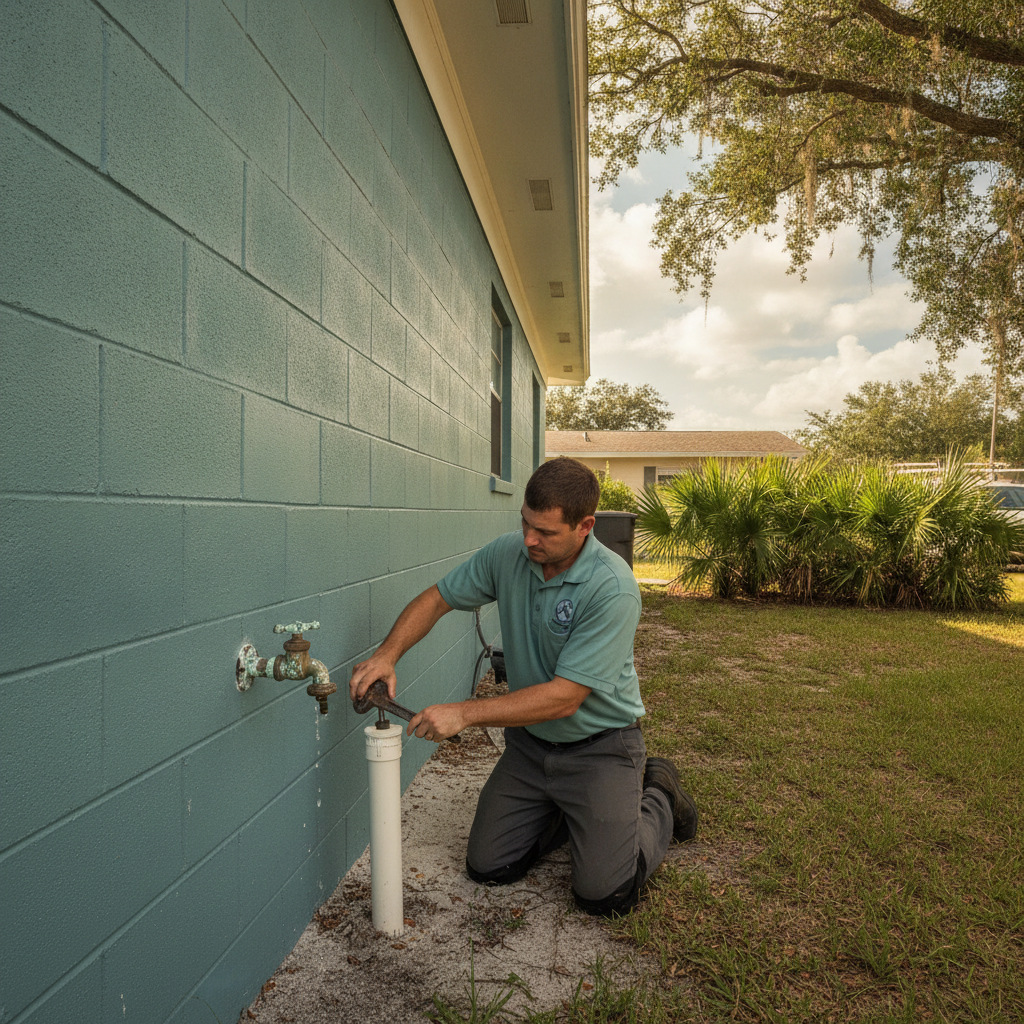
The hose bib on the west wall of a 1962 ranch near East Bay Drive looks fine until you lean on it. Chrome has gone chalky, the vacuum breaker is frozen, and the valve weeps into painted block. That is the work Largo plumbers actually get: salt air on outdoor fittings, and drain lines that have sat under the same tight lot since the slab was poured. We match you with licensed local plumbers. The plumbers we send are licensed and insured.
Why Largo plumbers deal with salt air and old drains
Largo sits in central Pinellas, a few miles inland of the Gulf beaches, on city water and city sewer. It is not Pasco well country. It is not a 1920s street in Old Northeast. The housing that defines it is postwar and mid-century: ranches, split plans, and compact lots along Ulmerton Road, East Bay Drive, and the blocks that run west toward Belleair.
Salt does not need a beach address to work. Wind off the Gulf carries it across western Pinellas. It settles on hose bibs, pool equipment, and any steel fitting that lives outside. Sun cooks the same parts. Hard water, which runs 11 to 17 grains per gallon across Tampa Bay, leaves crust inside those valves while salt pits the outside.
Under the lawn, the story is age. A house built in 1960 still often uses its original building sewer under the slab or the side yard. Cast iron and early plastic both live here. Roots find the joints. Kitchen grease coats the upper half of the pipe. After a summer storm, groundwater around a shallow lateral rises, and a line that drained yesterday starts to gurgle.
Pinellas plumbing in this belt is access work as much as pipe work. Lots are tight. Driveways cover laterals. A fence sits on the property line. The licensed plumber on site works in that strip, which is why a camera through a cleanout beats a guess from the roof vent.
Hurricane season runs from June through November. That stretch means extra wash loads, extra guests, and extra outdoor rinses through the same old laterals, now sitting in wetter soil. The National Weather Service Tampa Bay office covers the storm track. The plumbing side is the pipe you already have.
Some Largo streets include manufactured homes with plumbing hung in the belly of the unit. That layout is a different repair from a ranch lateral under concrete. Either way, the outdoor fittings still face the same salt.
We cover Largo with the rest of Hillsborough, Pinellas, and Pasco. Matching is local on purpose. A plumber who already knows how these ranches were stacked will not treat your side yard like a five-acre lot in Odessa.
Cast iron, galvanized, and tight Pinellas lots
Cast iron drain pipe was the default for decades of Florida residential work. It is strong when new. It also rusts from the inside. Scale builds, the interior roughens, and paper and grease hang up on the rust. Joints open enough for roots. In a Largo ranch, that pipe often runs under the slab or just outside the foundation, then across a short, fenced side yard to the city sewer in the street.
That is a cousin of the bungalow problem, not a copy. The cast iron failure pattern in St. Petersburg is older stock, tighter bungalow footprints, and trees that have had seventy years to find the joints. Largo’s mid-century ranches are newer than those bungalows and often shorter in run, but the metal is the same chemistry. Once the interior is scaly, snaking buys time. It does not put the wall back.
Galvanized steel on the supply side is the other mid-century leftover. It corrodes from the inside out. Buildup narrows the interior until the shower at the far end of the house feels weak. Tampa Bay hard water speeds that along. Galvanized is well past the 40 to 50 year life people still quote for it, which is why Pinellas Park homes from 1950 to 1985 still show it, and why Largo houses from the same decades show it too. Leaks cluster. Patch one coupling, and the next one is already thin. When that starts, the long-term move is a whole-home repipe, not a third clamp.
Tight lots change the repair. There is little open lawn. A boat, a shed, or a paver patio sits on the lateral. The plumber works from a cleanout if one exists. Florida’s plumbing code wants cleanouts on new work at the junction of the building drain and the building sewer, along long runs, and at sharp turns. An older house was not built to that book. Many Largo ranches have one usable cleanout, or none you can find without a probe. Required cleanouts on new work also have to come to grade and stay out of concealed spots, which is why a buried, forgotten fitting in a side yard is so common on a 1960s lot.
Pinellas County Utilities, for customers in its wastewater service area, treats a missing cleanout cap as one of the conditions that can make a private sewer lateral defective under its permitting policy. That is a definition inside a permit process, not a fine that arrives in the mail. It is still a reason to keep the cap on and the opening findable.
If the camera shows a collapsed section or a belly that holds water, the job moves from cleaning to sewer line repair. Putting the driveway or the pavers back is often the slow part, because there is nowhere else to put the trench.
Fixtures that crust, and drains that slow on city sewer
Indoor fixtures in Largo fail the quiet way. Hard water leaves scale on shower heads, in faucet aerators, and inside older cartridges. A shower that used to spray now dribbles. A kitchen faucet hisses because the aerator is half shut with mineral. That is the same 11 to 17 grain water the rest of the metro lives with, plus whatever outdoor salt has done to the hose bib you use to rinse the car.
Outdoor spigots take the beating first. Salt air pits chrome and cheap zinc. The handle seizes. The sillcock weeps behind the stucco. Florida’s residential code requires a vacuum breaker on hose bibs and wall hydrants so a submerged hose cannot pull yard water back into the house. The two exceptions in that section are drain valves meant only to empty a water heater or boiler, and washer valves that already have backflow protection. A garden hose bib is not either one. When a breaker is missing or frozen solid, the licensed plumber replaces the fitting, not just the rubber washer.
A single fixture that backs up is often the trap or the branch: hair in the bath, grease in the kitchen, wipes in the toilet. Drain cleaning through that fixture or a nearby cleanout clears it. Not every pipe should be jetted. Grease and soap scum flush well with water. A camera after a clearing shows whether the wall is still round or already offset.
Several fixtures slow at once, or a toilet gurgles when the washing machine drains, and the problem has moved to the building drain or the lateral. That is city-sewer work, not a septic tank. Largo is not Land O’ Lakes. There is no drain field to saturate in August. There is a pipe to the main, and it can belly, crack, or fill with roots the same way older Tampa sewer lines do.
A wet stripe in the yard, a soft patch over the run, or sewage at a cleanout after rain is the lateral talking. A camera inspection sees the offset, the scale, or the root mass. Pinellas County Utilities runs a rebate for eligible single-family customers who inspect, repair, replace, or line a private sewer lateral. Funds go first come, first served. The plumber has to hold a Pinellas County Construction Licensing Board credential, and the application has a deadline after the work is done. The rebate’s published scope is that lateral. It does not say it pays for a new cleanout or a pump. Confirm from your bill that you are actually their customer, then ask the county whether your job qualifies.
If you are not a county utility customer, the mechanism is the same: camera, then clean or repair. The paperwork is not.
How Largo differs from St. Pete bungalows and Pinellas Park
A page that could be about any Pinellas city has failed. The plumbing here splits by housing and by how close the lot sits to the Gulf, not by swapping a city name in the headline.
| | Largo | St. Petersburg bungalows | Pinellas Park | | Housing stock | Mid-century ranches and tight suburban lots | Pre-1975 bungalows, older and smaller footprints | 1950 to 1985 subdivision stock | | Water and sewer | City water and city sewer | City water and city sewer | City water and city sewer | | What the air does | Gulf salt reaches western Largo fittings | Salt is heavier toward the beaches and islands | More inland, so outdoor fittings last longer | | Typical pipe trouble | Aging laterals plus salt-eaten hose bibs | Cast iron under the house, roots, old joints | Galvanized supply that has narrowed from the inside | | Lot access | Side yards, fences, driveways over the run | Tight bungalow slabs and mature trees | Similar suburban laterals, a little more lawn |
St. Pete’s older bungalows are the cast-iron story: thinning pipe, roots at hub joints, and houses that predate the current cleanout rules. Largo has some of that metal, in younger form, under ranches instead of bungalows. The salt load is real, and it is lighter than on Pass-a-Grille, but it is not nothing. Hose bibs and pool fittings on the west side of town show it first.
Pinellas Park’s common plumbing problems lean toward galvanized supply in that 1950 to 1985 belt, with less Gulf air on the outdoor fittings. Largo shares the galvanized era and adds the salt. Both sit on city sewer. Neither is the Pasco pattern of wells, septic tanks, sandy soil, and a high water table in Land O’ Lakes, Odessa, or Wesley Chapel.
That difference decides the first question on the call. A backup in Largo is almost always a fixture, a building drain, or a city lateral. A backup in Wimauma can be a saturated drain field. Mixing those up wastes a trip and the wrong kind of truck.
Questions Largo homeowners bring us
Searches for the best Largo plumbers usually mean you want someone licensed, who will camera the line, and who already works tight Pinellas lots. Start there, then match the job to the house you actually have.
How do I find licensed Largo plumbers?
Look up the contractor on the Florida DBPR license search before anyone opens a cleanout. A state plumbing license is the floor. The plumbers we send are licensed and insured. If you are applying for a Pinellas County Utilities lateral rebate, that program also wants a plumber who is certified or registered with the Pinellas County Construction Licensing Board. Ask how they will camera the line on a fenced lot, and what they will do if the pipe is scaled instead of clogged. Choosing a licensed plumber in Tampa Bay walks through that check without the sales pitch.
Does Largo sit on city sewer or septic?
Most Largo neighborhoods sit on city water and city sewer. Well and septic are the Pasco and rural Hillsborough pattern: Land O’ Lakes, Odessa, Thonotosassa, Wimauma, Balm. If your lot is one of the uncommon pockets still on a tank, we will line you up with a licensed and registered septic contractor. Do not treat a Largo ranch backup like a drain-field failure unless you already know you are off the city main.
Why do several drains slow at once?
A single slow tub is usually hair in that branch. Several fixtures slowing together, a toilet that gurgles when the washer drains, or a wet stripe over the side yard means the building drain or the lateral is holding water. That is licensed plumber work: camera first, then a clearing or a repair, depending on what the wall of the pipe looks like. Opening a main or cutting a trench on a tight lot is not a weekend project.
When to call us
A drain that will not hold a clearing, a hose bib that weeps into the block, or a wet stripe in the yard over the lateral needs a licensed plumber. We match you with licensed local plumbers who already work Largo lots. Call us at (813) 590-0625.