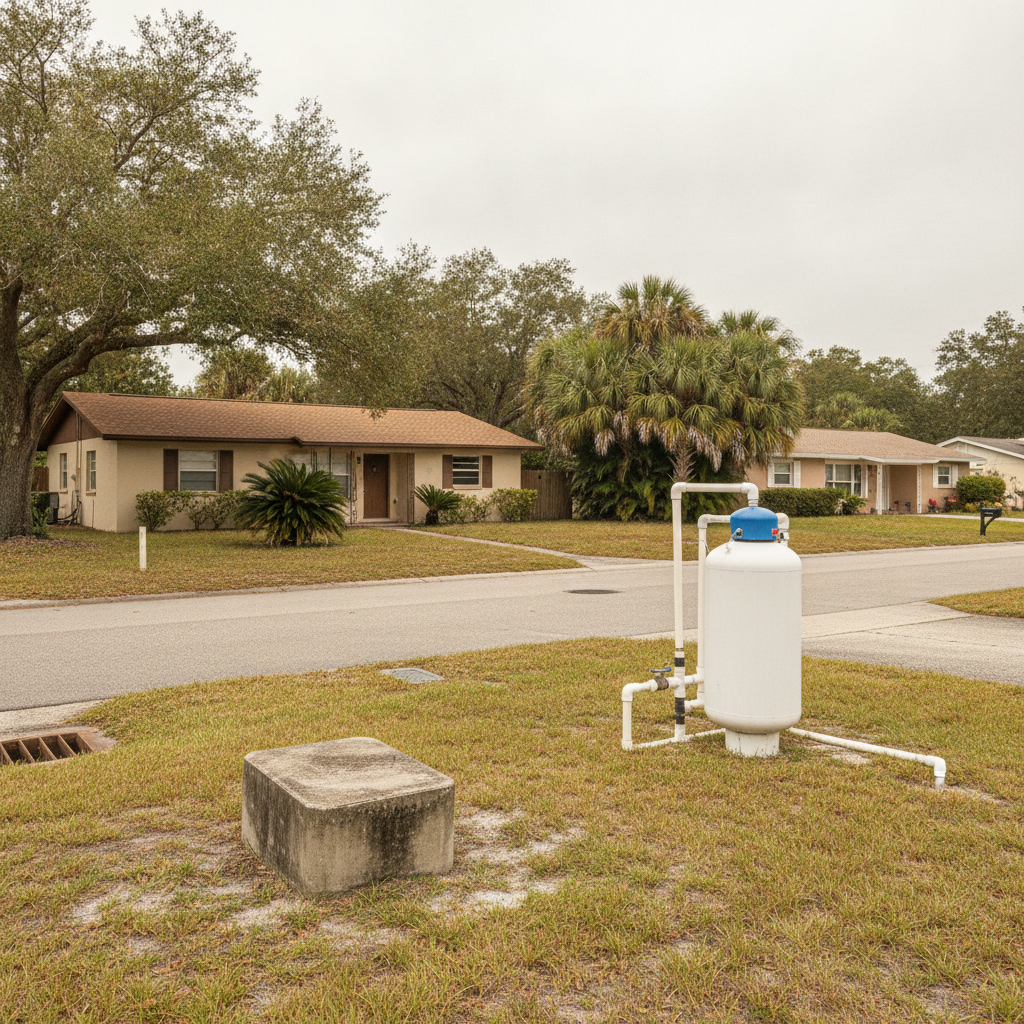
Cross County Line Road and the plumbing changes. One ranch drinks City of Tampa water from a meter in the grass. The next lot runs a well pump and a pressure tank. That is Lutz plumbing in one picture: two systems, two counties, and two kinds of service calls on the same block.
We match homeowners with licensed local plumbers who work both sides of that line. If you need plumbing help in Lutz, start by knowing which water system you are actually on.
Why Lutz plumbing sits on two systems at once
Lutz straddles Hillsborough and Pasco. South of the county line, a lot of streets sit on municipal water, including City of Tampa service on Hillsborough lots. North of it, larger Pasco lots still pull from private wells. A mailbox that says Lutz does not tell you which one you have.
City-water homes fail like closer-in Tampa ranches. Scale loads the heater. A supply line weeps under a slab. 1990s copper starts to pit. Well homes fail like Odessa and the rest of the Pasco belt. A pressure tank short-cycles. A pump will not rebuild pressure after a storm. Hot water smells like rotten eggs while the cold side is fine.
The split is sitting in the yard. A plastic meter box in a direct line with the front hose bib means city water. A well casing, a tank on a pad, or a control box on the side of the house means you own the supply from the ground up. Shut the house valve and watch. On city water the meter stops when the house is off. On a well the pressure switch stops calling for the pump.
Licensing follows the same map. Search the contractor on Florida’s DBPR licensee search before anyone opens a slab or pulls a pump. You want an active plumbing contractor license. The plumbers we send are licensed and insured, and a Lutz address can sit in either county.
Septic shows up on the Pasco side the same way wells do, the way it does in Land O’ Lakes, Wesley Chapel, and Odessa. If the tank or drain field is the problem, we will get a licensed and registered septic contractor out. Florida’s onsite sewage program sits with DEP, and the Pasco County health department still handles local permitting and inspection.
City of Tampa water on one street, a well on the next
City of Tampa water arrives at a meter. Past that meter the pipes are yours. Street pressure feeds the house. Most Tampa Bay utilities land somewhere around 45 to 60 psi at the meter under normal use. When static pressure inside the building exceeds 80 psi, Florida’s plumbing code requires a pressure-reducing valve on the building lines. Hose bibs and outside hydrants can stay on the street side of that valve. Most newer city-water construction already has one near the main shutoff.
A well house has no street pressure. It has a pump, a pressure tank, and a switch that cuts the pump in and out of a set band. When the tank loses its air charge, the pump short-cycles. When the switch sticks, you get no water, or a pump that never stops. That is a well pump repair call, not a ticket to the City.
After a hydrant flush, City of Tampa customers can see temporary discoloration from silt in the mains. The City’s water-quality pages describe that as silt and precipitates, and say to run the outside hose bib first, then indoor cold, until it clears. If only the hot side stays rusty, the tank is shedding sediment. A water heater that is corroding internally stains the hot taps and leaves the cold side clean.
Well water brings iron, sulfur, and sediment into the tank, the anode, and the fixtures. Conditioning happens on the house side. The Pasco well-water treatment path is filtration and a softener where the water needs it, not a call about a Tampa main. Hot water that smells like rotten eggs after the house sat empty is often the magnesium anode reacting with sulfate in the tank. City heaters can do the same thing after a long idle stretch. Wells make it a regular conversation.
Lightning is a well-house problem. A strike or a nearby surge takes out the control box, the pressure switch, or the above-ground wiring. Florida draws well-contractor work at the ground surface and outside the pumping equipment, so the parts that actually fail in a storm are plumbing and electrical scope. Leave the control box closed. Capacitors hold a charge. The lightning and well-pump walkthrough is the right next read if the pump died during a storm.
| What you are looking at | City of Tampa water | Private well |
|---|---|---|
| What feeds the house | A meter at the street and utility pressure | A pump, pressure tank, and switch on your lot |
| What usually fails first | Heater scale, copper pinholes, a slab leak under a ranch | The pump, the tank bladder, or the pressure switch |
| Who owns the buried supply | The utility to the meter, you from the meter in | You, from the wellhead to the last fixture |
| What the other system cannot teach you | Hydrant flushing and street-side pressure | How the tank and switch are supposed to cycle |
Scale, slab leaks, and the county-line housing mix
Lutz housing is a stack of decades. Closer to US-41 and the old town center you get ranches and additions from the 1970s and 1980s. Toward County Line Road and the Wesley Chapel edge you get newer slab-on-grade houses with PEX or copper that is only now entering middle age.
Mineral scale works on both systems. It crusts shower heads, loads heater dip tubes, and shortens a tank’s life whether the source is a Tampa main or a Pasco well. We recommend flushing a tank heater on a six-month cycle here, because sediment drops out of Tampa Bay water faster than the annual habit people bring from somewhere else. The hard-water and water-heater page walks through what that scale does inside the tank.
1990s Lutz copper is in the age range where pitting and pinhole leaks become more common. One pinhole does not automatically mean the whole house is finished. A second leak, or visible pitting on exposed joints, is when a full repipe starts to make more sense than another patch. A typical Lutz whole-home repipe runs $6,000 to $15,000. Late-1970s to mid-1990s supply can also still be polybutylene, the gray plastic that fails at the fittings. That belt is famous in Brandon and Valrico. It shows up in Lutz houses of the same vintage.
Slab leaks follow the ranch. Supply lines under a slab-on-grade floor sit in sand. A pinhole or a failed poly-b fitting weeps into the fill. You see a warm streak in the tile, a toilet that refills on its own, or a bill that jumped while the house sat quiet. Slab leak repair starts with finding the line. Leak detection on this site, applied toward the repair, runs $250 to $450.
Drains are a third story. Older Lutz ranches can still have cast iron under the slab. Pasco lots can sit on septic rather than county sewer. A backup in a well-and-septic house is a different job from a City of Tampa lateral. For that decision, read septic vs sewer in the Tampa suburbs. When the tank or drain field is involved, we line you up with a licensed and registered septic contractor.
How Lutz differs from Land O’ Lakes wells and Carrollwood city water
Land O’ Lakes plumbing is the well-and-septic suburb people picture when they think Pasco. Larger lots, sandy soil, a high water table, and August storms that saturate a drain field. The house there is a well pump, a pressure tank, and a septic system until a sewer main actually arrives.
Carrollwood sits closer to Tampa and reads as municipal plumbing: meters, laterals, heaters on city water, slab leaks in the older subdivision stock. Lutz borrows that pattern on the Hillsborough streets. Two doors north, the same floor plan can be on a well. A plumber used only to Carrollwood will look for a meter that is not there. A plumber used only to Land O’ Lakes will talk septic to a house on city sewer.
Wesley Chapel, just east, is more uniformly new and more uniformly Pasco. The well-and-septic pattern holds more of the time. Lutz is the seam between that Pasco belt and inner Hillsborough. That is the whole reason a Lutz job has to start with the yard: meter or tank, city lateral or septic, Hillsborough or Pasco.
How do I tell if my Lutz house is on city water or a well?
Look for a meter box near the street in line with the front hose bib. That is city water. A well casing, a pressure tank, or a pump control box on the lot means a private well. Your water bill names the utility if you are on one. No bill and a tank in the yard is the well.
How do I check that a plumber is licensed in Florida?
Search the contractor on Florida’s DBPR licensee search. You want an active plumbing contractor license, not a van and a card. The plumbers we send are licensed and insured, and a Lutz job can sit in Hillsborough or Pasco, so the person who shows up needs to work both. How to choose a licensed plumber in Tampa walks through that check.
What usually breaks first on each Lutz system?
City-water ranches send heater scale, copper pinholes, and slab leaks. Well lots send pump, tank, and switch failures, plus sulfur on the hot side. A slow drain in an older ranch is often the cast iron or a clogged line. A backup on a Pasco lot can be the septic system, which is a licensed and registered septic contractor’s job.
When to call us
Call when the well will not rebuild pressure, the heater is staining the hot side, or a warm streak in the slab says a line is open under the house. We match you with a licensed plumber for city-water work and well work, and we will get a licensed and registered septic contractor out when the tank or drain field is the problem. Call us at (813) 590-0625.