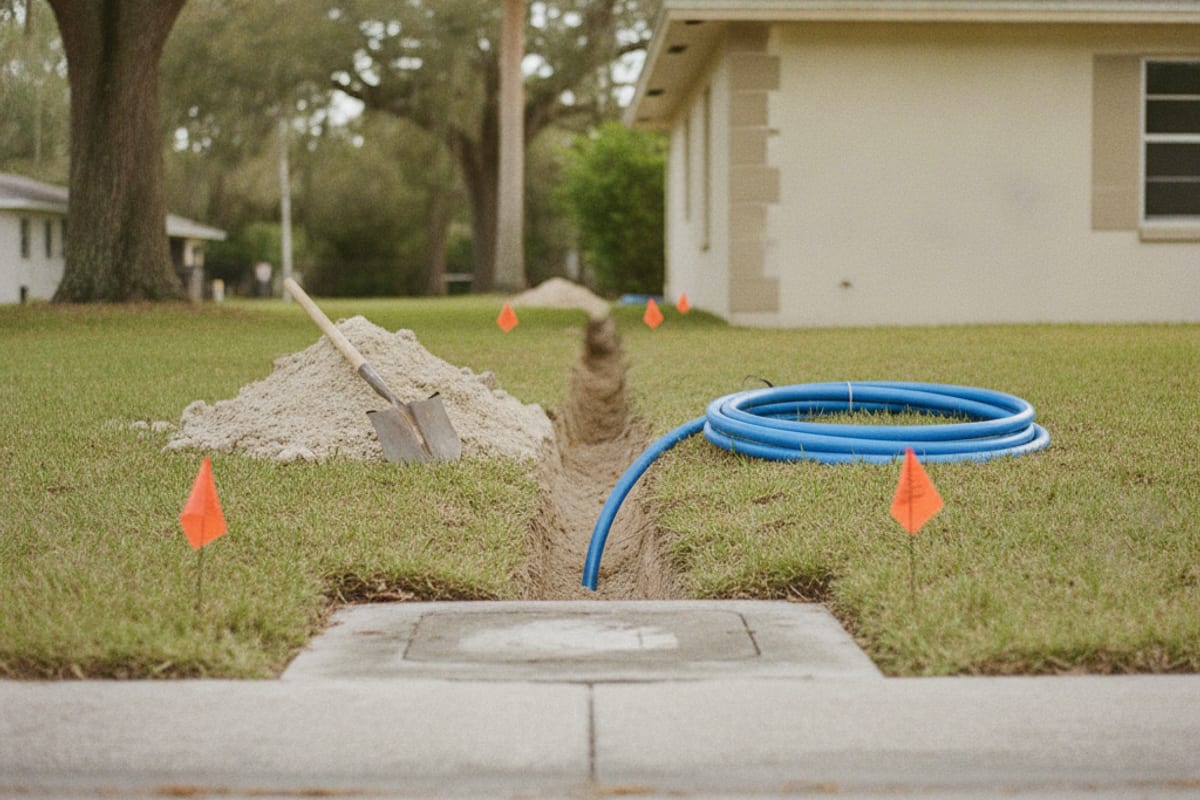
Water line replacement in Tampa Bay means replacing the buried pipe that carries drinking water from your meter at the curb to the wall of your house, and it is a different job from repiping the plumbing inside your walls. One pipe, usually three quarters of an inch or an inch, often forty to eighty feet long, frequently running under a driveway or a stand of live oaks. The part most homeowners get wrong is the sequencing. There are two permits involved, they move at very different speeds, and a code rule about where that pipe can sit relative to your sewer decides the route before anybody picks up a shovel.
What the water service line actually is
Your house has three buried pipes that people mix up constantly. The water service line brings potable water in from the meter. The building sewer carries waste out to the main or to a septic tank. And the distribution piping is everything downstream of the point where the water service enters the house, the branches feeding your showers and your kitchen sink.
Replacing the water service is not a repipe. A whole-house repipe swaps the distribution piping inside the walls and under the slab, and the cost drivers there are drywall, fixtures and access. A water service replacement is a single run of pipe outdoors, and its cost drivers are what sits on top of it. A driveway apron. A sidewalk. Thirty years of root mass from the oak the builder planted in 1988. It is also not a slab leak, which happens under the foundation on the distribution side.
The ownership question, which is the one we hear most on the phone, has its own answer. Our guide to water line repair in Tampa Bay walks through where the utility’s responsibility ends, how to read your meter to confirm the leak is outside the house, and what the local utilities will and will not credit back after a repair.
When repair stops making sense
A plumber stops patching a water service when the failures start clustering. That is the honest threshold, and it has nothing to do with the age printed in the property record.
Galvanized steel is the clearest case. Galvanized supply lines corrode from the inside, and the buildup narrows the interior diameter until pressure drops off, worst at the far end of the run. Once it starts failing it fails in clusters, so patching one leak usually means the next one is a few months out. Those lines are well past their expected forty to fifty year lifespan, and Tampa’s hard water speeds the internal corrosion along. If you are on galvanized and you have already paid to dig the yard twice, the third dig is the one that should be a replacement. Our breakdown of galvanized pipe replacement cost in Tampa Bay covers the inside-the-house half of that decision.
Polyethylene and copper services fail differently. Copper gets pinholes. Polyethylene usually fails at a fitting or where something crushed it. A single clean failure on an otherwise sound line is a repair, full stop. What tips it toward replacement is a second failure in a different spot, a line you can’t locate a leak on without opening the yard in three places, or a run so shallow that lawn equipment keeps finding it.
Finding out which situation you have costs something, and that part we can quote. Leak detection runs $250 to $450 and gets applied toward the repair. That is money well spent before you commit to a route, because the locate is what tells you whether you are dealing with one bad fitting or a tired pipe.
Two permits, two very different clocks
Here is the part nobody mentions until the quote arrives.
A plumbing permit is required. Florida’s 2026 permit exemption, the one that made headlines as waiving permits for work under $7,500, specifically does not cover this. The enrolled text of CS/CS/HB 803 directs local governments to exempt an owner of a single-family dwelling or the owner’s contractor “from the requirement to obtain a building permit to perform any work valued at less than $7,500 on the owner’s property,” and then lists what the exemption does not apply to, including “any electrical, plumbing, structural, mechanical, or gas work performed on property containing a single-family dwelling.” Plumbing is named. The act takes effect July 1, 2026, and it also closes the obvious workaround: “A construction project may not be divided into more than one project for the purpose of evading the requirements of this paragraph.”
The permit itself is not the expensive part and it is not usually the slow part either. The City of Tampa’s trade permit fee schedule prices residential plumbing (general) at $120.00, and Hillsborough County’s schedule prices the same line at $130.00. Tampa’s schedule notes that “All permits are subject to the Florida Building Permit Surcharge (2.5% of permit value or $4.00 minimum),” which is charged on top. Those are the permit lines only, not the job, and jurisdictions outside those two publish their own numbers. HB 803 also added a five business day clock: a local government has to approve, approve with conditions, or deny within “5 business days after receiving a complete and sufficient application” for a plumbing permit on an existing single-family home where the work is valued under $15,000, for an applicant using a local government plans reviewer.
Now the second permit. If any part of the work happens between your property line and the street, you are in the public right of way, and inside the City of Tampa that is a separate approval. The city’s rule covers “All installation(s), construction, and/or maintenance activities, which take place within the City of Tampa rights of way,” and the city states that “The right of way permit review and approval process takes approximately twelve (12) to fifteen (15) business days.” Applications go through the city’s online permitting portal and a certificate of insurance is part of the package.
Read those two clocks next to each other. The plumbing permit can clear in a week. The right of way permit, on a City of Tampa job that has to cross the parkway strip, takes two to three weeks of review before anyone cuts anything. A plumber who plans a route that stays entirely on your side of the property line is not cutting a corner, they are avoiding a three week wait. That is why the first question a good estimator asks is where your meter sits relative to your property line, not how long the run is.
The code decides the route before the yard does
The Florida Building Code, Plumbing, 8th Edition (2023) sets the constraints that shape where a replacement line can go, and they are more specific than most homeowners expect.
Size comes first. Section 603.1 requires that a water service pipe “shall be sized to supply water to the structure in the quantities and at the pressures required in this code,” and that it “shall be not less than 3/4 inch (19.1 mm) in diameter.” That is a floor, not a target. A long run to a two-story house with a lot of fixtures gets sized up.
Material is next. Section 605.3 requires water service pipe to conform to NSF 61 and to one of the standards in its materials table, which includes cross-linked polyethylene, polyethylene, copper tubing, CPVC, ductile iron and several others. It also sets a pressure floor that matters outdoors: pipe or tubing “installed underground and outside of the structure, shall have a working pressure rating of not less than 160 psi (1100 kPa) at 73.4°F (23°C).” Burying interior-grade pipe because it was on the truck is a failed inspection, not a shortcut.
Then comes the rule that actually moves trenches. Section 603.2 separates the water service from the building sewer. Where the sewer is not built of the materials in the code’s own table, “the water service pipe and the building sewer shall be horizontally separated by not less than 5 feet (1524 mm) of undisturbed or compacted earth.” There are two ways around it, and both are engineering, not paperwork. A crossing is allowed where the water service is sleeved “to a point not less than 5 feet (1524 mm) horizontally from the sewer pipe centerline on both sides of such crossing.” And the separation does not apply where the bottom of the water service, sitting within five feet of the sewer, is “not less than 12 inches (305 mm) above the highest point of the top of the building sewer.”
On a narrow Seminole Heights or Palma Ceia lot, five feet of clear earth is a real constraint. The old service often runs more or less alongside the sewer because that is where the builder put both of them, and a replacement on the same line either needs the sleeve or needs to come up and over. Section 603.2.1 adds one more, and it reshapes jobs across Pasco and rural Hillsborough: potable water service pipes “shall not be located in, under or above cesspools, septic tanks, septic tank drainage fields or seepage pits.” A Land O’ Lakes or Thonotosassa property with a drain field in the front yard has fewer legal routes to the meter than the yard appears to offer.
Open trench or directional boring
Two methods, and the choice is made by what sits between the meter and the house.
| Open trench | Directional boring | |
|---|---|---|
| How it works | A continuous cut from the meter to the house, pipe laid in, backfilled and compacted | A boring head is steered underground from a small pit at each end and the new pipe is pulled back through |
| Best when | The run is short, the ground is open lawn, and the old pipe needs to come out | Something on top of the route can’t be disturbed, like a driveway, a paver walk, a mature root system or a sidewalk in the right of way |
| What it costs you above ground | Restoration of everything the cut crossed, which on a paver driveway is the biggest line on the invoice | Less surface damage, but mobilization for the equipment and a more involved locate before anyone drills |
| Where it struggles | Hard surfaces and roots, both of which turn a day into three | Shallow utilities crossing the path, since the head has to be steered around them |
| Code picture | Separation from the sewer is easy to see and verify in an open cut | Separation and depth have to be designed and tracked, since nobody is looking at the sewer while the head is moving |
Tampa Bay pushes jobs toward boring more than most markets do, for a plain reason. Lots here are shallow front to back, meters sit at the curb, and the thing between the meter and the house is very often a driveway or an oak. Sandy Pasco soil bores cleanly. The clay and limestone pockets closer to the bay do not always cooperate, which is why a bid that commits to a method before anyone has located the existing line should make you ask a follow-up.
What drives the number on the quote
There is no single going rate for this, and anyone quoting one over the phone before locating your line is guessing. What moves it is knowable, though, and you can estimate your own position on the scale before the truck arrives.
- Length of the run and the depth it has to sit at, because both set how much ground gets moved and how much pipe gets bought.
- What is on top of the route, which is the single largest swing: open St. Augustine lawn restores cheaply, a stamped concrete driveway does not.
- Whether the work crosses into the public right of way, which adds the separate permit and its two to three week review inside the City of Tampa.
- Whether the sewer’s position forces a sleeve, a vertical offset, or a route that is longer than the straight line.
- Material and size, since a longer or higher-demand run gets sized up past the code minimum.
- Restoration, meaning sod, pavers, concrete and irrigation lines that got cut, which is often billed separately from the plumbing.
Two things sit outside that list. The permit fees above are published by the City of Tampa and Hillsborough County and are the permit line only. And if a leak has already run up your bill, the credit question is separate from the repair question: our guide to a high water bill in Tampa covers what each of the four local utilities asks for before it will consider an adjustment.
One more Tampa-specific wrinkle. The city’s development manual, which governs how new water services get set rather than how existing ones get replaced, puts single-family meters “within two (2) feet of the side property line or as directed by the Department” and keeps trees away from public water facilities. That is why your meter is where it is, and why the shortest path from it to your house is sometimes a diagonal across the whole front yard rather than a straight shot.
Frequently asked questions
Is water line replacement the same as a repipe?
No. A repipe replaces the distribution piping inside the house, the branches running to your fixtures. A water line replacement swaps the single buried run between your meter and the exterior wall. Different crews sometimes, different permits often, and completely different cost drivers. Some older homes genuinely need both, and in that case the buried run is usually done first so the new interior pipe isn’t fed by a failing service.
Do I need a permit to replace my water service line in Florida?
Yes. Plumbing work on a single-family dwelling is specifically carved out of Florida’s under-$7,500 permit exemption in HB 803, so the dollar value of the job doesn’t get you out of a permit. If the work also reaches into the public right of way, that’s a second permit with its own review timeline, and inside the City of Tampa that review runs about twelve to fifteen business days.
How deep does a water service line have to be buried?
The Florida Plumbing Code doesn’t set a single depth number for a water service the way it sets a minimum diameter. What it does set is a relationship: the line has to hold the required five feet of horizontal separation from the building sewer, or qualify for the sleeve exception at a crossing, or sit at least twelve inches above the top of the sewer within that five foot zone. Practical depth also has to clear whatever drives over it. Your inspector and the local utility standards settle the final number.
Can the new line follow the same path as the old one?
Often, but not always. If the old service was laid alongside the sewer closer than five feet and the sewer isn’t one of the materials the code allows in a shared trench, the same path needs a sleeve or a vertical offset to pass inspection. On lots in Pasco and rural Hillsborough, the drain field rules it out entirely in places, since potable water service pipe can’t run in, under or above a septic tank or drain field.
What pipe material gets used for a replacement in Tampa Bay?
The code’s water service materials table allows several, including cross-linked polyethylene, polyethylene, copper and CPVC, and whatever goes in has to conform to NSF 61 and carry a working pressure rating of at least 160 psi at 73.4°F underground. In practice around Tampa Bay you see continuous-roll polyethylene on bored runs, because a single length with no buried joints is the part that matters most in sandy, wet soil.
How long does the work take once it starts?
The digging and pulling is usually a one to two day job on a typical residential run. The calendar is set by what comes before it: the locate, the plumbing permit, and if the route crosses the right of way, that separate city review. Plan around the approvals, not the excavation.
When to call us
Call when you’ve got a second failure on the same buried line, when your meter keeps turning with every fixture in the house shut off, or when a locate has already told you the run is tired rather than damaged in one spot. This is licensed work with inspections attached, and the permit side alone is enough reason not to hand it to a handyman. We’ll match you with a licensed plumber who pulls the permits, works the right of way question before it becomes a delay, and gives you a real number after locating your line instead of a range over the phone. Call us at (813) 590-0625.