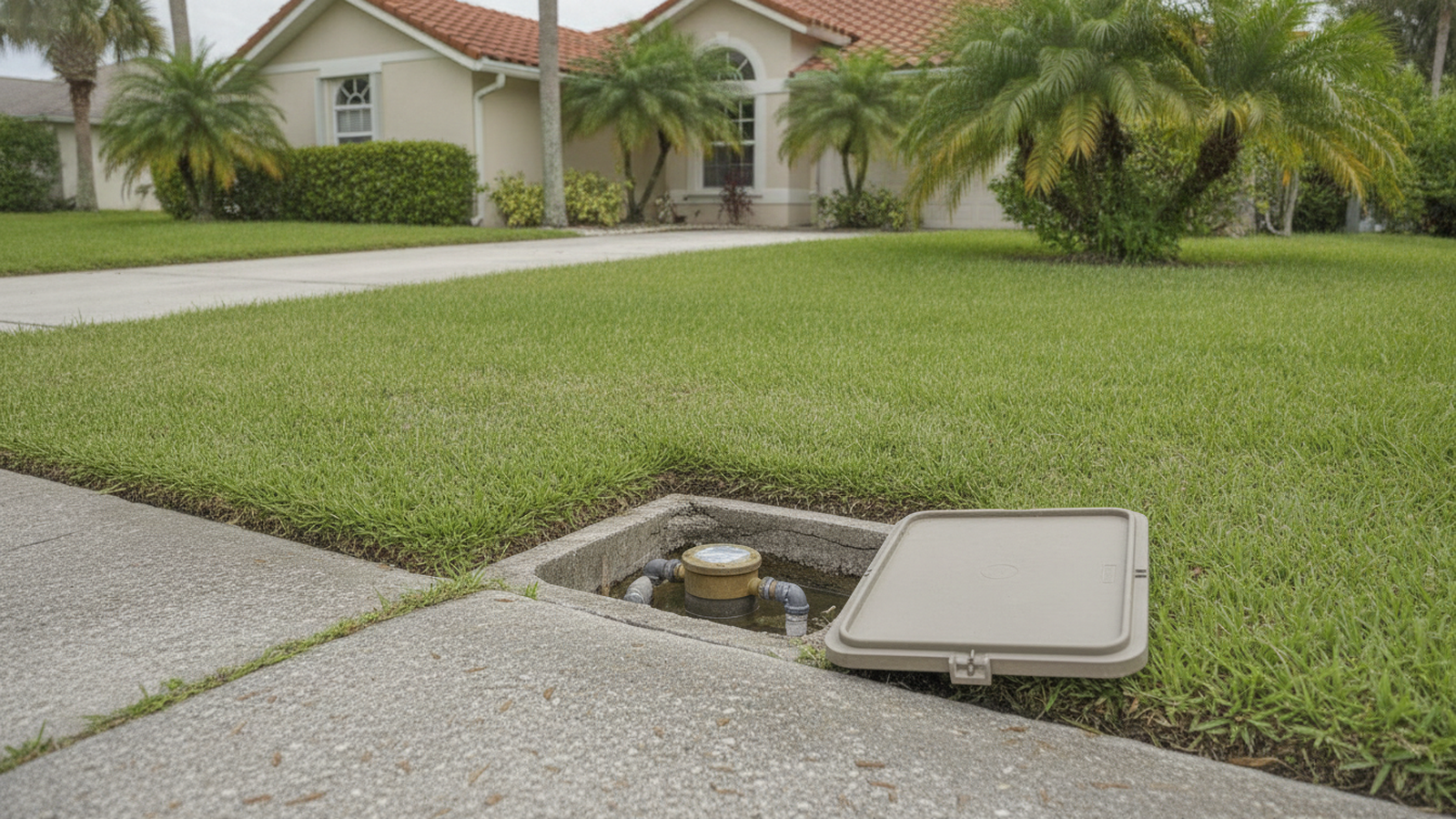
A high water bill in Tampa Bay is either a change in use or a leak, and the water meter settles which one in about two hours. Shut off every fixture, read the meter, wait, then read it again. If the number moved, water is going somewhere. Every Tampa Bay utility that offers a bill credit requires the leak to be repaired first, with proof.
What causes a high water bill in Tampa Bay?
A higher bill comes from one of two places: you used more water, or water got out through a leak. The City of Tampa’s own examples of a use change are a bigger household, watering new sod, pressure washing, and filling or topping off a pool. Those you’d remember doing.
Leaks are harder to spot. A toilet runs quietly between flushes. A water softener gets stuck on backflush and keeps drawing water. An irrigation zone runs when nobody’s watching it.
The City of Tampa’s high-bill guidance shows how even a small leak adds up. The city says a faucet “dripping one small drop per second can waste 7 gallons per day, or more than 2,500 gallons per year”.
A leaking toilet moves water from the tank into the bowl without much noise. Hillsborough County’s fix for that is a dye test: add a few drops of food coloring to the toilet tank, then wait about 15 minutes. If color shows up in the bowl, water’s moving from the tank into the bowl without anyone flushing. That’s a repair, and the plumbers in our Tampa Bay network handle toilet repair across the metro.
The bill by itself won’t tell you which of the two it is. The meter will, because it shows whether water is moving while the house is quiet.
How do you test your water meter for a leak?
You run a two-hour meter test, and it separates normal use from water that never stops moving. Hillsborough County spells out the rule: “Wait two hours, making sure not to use any water in your home or lawn, and then check your water meter again. The two readings should be identical.” If they aren’t identical, you’ve got a leak to find. Your meter sits in a plastic box out at the curb, in line with the main outdoor faucet, according to Hillsborough County.
- Find the meter reading printed on your latest bill, then compare it with the current meter reading.
- Choose a two-hour period when nobody needs water. Turn off faucets, appliances, irrigation, and other scheduled water use.
- Record the meter reading or take a clear photo before starting.
- Wait two hours without using water in the house or yard.
- Read the meter again. Movement means a fixture, appliance, irrigation system, or pipe used water during the test.
- Close the private house valve and watch the meter again. Our water shutoff guide explains how to find and operate that valve.
Pasco County Utilities says the same thing about the window: “Do not use any water for a period of two hours (or overnight).” Pasco also warns that sprinklers and water softeners can pull a lot of water on their own automatic cycles, so a moving meter isn’t proof by itself. Run the test when those systems are idle.
The bill comparison catches something different. City of Tampa guidance says “The reading on the meter should be greater than the one shown on your bill.” If yours is lower, that’s a billing read to question, not a leak, and City of Tampa customers can ask for a re-read through the Utilities Call Center at (813) 274-8811.
Hillsborough County runs its customers through the same check and gives a different number. If your reading is lower than the one on your bill, Hillsborough tells you to call (813) 307-1000; if it’s higher, the county says the read is correct. That’s the county utility, not the City of Tampa, so use the number that matches whoever bills you.
Is the leak inside the house or out at the meter?
Closing the house valve turns the meter into a boundary test, and it’s the step that saves you money. It narrows the search before anyone opens a wall, a floor, or the yard.
Pasco County Utilities puts it plainly: “If the meter continues to show usage after the house valve has been shut, the issue is likely outside the dwelling.” That points at the service line running from the meter to the house, or at something tapped in ahead of the valve, like an irrigation branch.
Go the other way and the answer flips. Pasco again: “If the meter does not move after closing the house valve, there may be an issue somewhere inside the home’s plumbing”. Now you’re looking at toilets, appliance connections, a softener, or a supply line you can’t see.
That’s as far as a homeowner can usually get, and it’s plenty. From there the pros we send bring leak detection equipment and pinpoint the water without guessing. An inside result doesn’t automatically mean it’s under the slab. If it does point below the floor, read up on the signs of a slab leak and how slab leak repair gets done here.
Once you find the leak, does the bill get fixed too?
Maybe, and only after the leak is repaired. Every Tampa Bay utility that offers an adjustment runs it the same way at the start: fix it first, then prove you fixed it. What none of them promise is a credit. Each page says you may be eligible, not that you are.
The one thing to do while the plumber is still standing there is collect the paperwork, because that is what the claim runs on. Tampa asks for “A copy of your plumber’s repair bill or a letter detailing what was repaired, including the date of repair and any receipts for materials used.” Pinellas County Utilities takes a plumber invoice, or a notarized Statement of Repaired Leak if you never got one. Hillsborough wants proof of repair. So keep the invoice, and ask for a written description of what got repaired and the date it happened.
Then know one thing before you get your hopes up. Hillsborough County publishes exclusions that rule out landscaping and new or replacement sod, garden hoses, spigot and faucet leaks, irrigation-well or pond cross connections, and anything tied to a swimming pool. Read that plainly: an outdoor spigot leak at a Brandon home served by unincorporated Hillsborough County is your cost, even after you fix it.
The rest of it gets specific fast, and the rules disagree with each other across the metro. We’ve written the whole comparison out already, utility by utility, in what your utility credits back after a leak repair. Read that one once you know where your leak is.
Frequently asked questions
Where is my water meter?
Out at the curb, almost always. Hillsborough County describes it as sitting “near the curb in front of your home or place of business in a direct line with the main outside faucet and housed in a plastic meter box.” Pasco puts it the same way: “Typically, the water meter is located in the front yard, near the street or sidewalk.” Once the lid is off, Pasco’s instruction is to “flip the meter lens cap to expose the meter face,” and it warns that “Dirt may need to be removed to expose the meter dial.”
Can a running toilet cause a high water bill?
Yes, and it’s the quietest way to run up a bill. Water slips from the tank into the bowl between flushes without a sound. Drop a little food coloring in the tank, wait about 15 minutes, then look in the bowl without flushing. Color in the bowl means water is getting through.
Does an outdoor spigot leak qualify for an adjustment?
Not in unincorporated Hillsborough County. The county’s page rules out spigot and faucet leaks along with sod, garden hoses and pool work. Tampa, Pinellas and Pasco don’t publish that same list, which isn’t permission, so call whoever bills you before you count on a credit.
What paperwork should I ask the plumber for?
An invoice or a written statement saying what was repaired and the date it was repaired, plus any receipts for materials. Tampa asks for exactly that, and Pinellas will take a notarized Statement of Repaired Leak instead if you never got an invoice. Get it before the plumber drives off; chasing it down later is harder than it sounds.
What if the meter doesn’t move during the test?
Then nothing was running continuously during those two hours, which rules a lot out but not everything. A sprinkler zone, a toilet or a softener backflush can still burn water on a cycle you slept through. Run the test again over the window you suspect, and check the bill against anything that changed at home.
Can a hidden pipe leak raise the bill without any visible water?
Yes. A buried or concealed supply leak moves the meter long before water shows up where you can see it. Close the house valve to learn which side of the meter it’s on, then let a plumber trace it with equipment instead of opening a wall to find out.
When to call us
Call once the meter keeps moving with everything shut off, or once you’ve run the tests and still can’t find the water. We’ll match you with a licensed local plumber who can pinpoint it, make the repair, and hand you the written documentation your utility is going to ask for. Reach us at (813) 590-0625.