Every trenchless pitch in Tampa Bay sounds the same: we fix the sewer line without digging up your yard. Sometimes that is exactly true. Sometimes the line cannot take a liner at all, and the honest answer is a trench. The difference is not a sales preference. It is what the camera finds inside the pipe, and it gets decided before anyone quotes a price.
What trenchless sewer repair actually is
Trenchless is not one method. It is a family of them, and only two matter for a house.
Lining, usually sold as CIPP, leaves the old pipe in the ground and builds a new pipe inside it. The EPA’s own fact sheet on the technique describes the process plainly: “a flexible fabric liner, coated with a thermosetting resin, is inserted into the existing pipeline and cured to form a new liner,” and “the thermosetting resin material bonds with the existing pipe materials to form a tighter seal than most other trenchless techniques.” The fact sheet says the method “can be applied to rehabilitate pipe lines with defects such as cracks, offset joints, and structurally deficient segments.”
Pipe bursting, which the EPA calls in-line expansion, destroys the old pipe and pulls a new one through the hole it leaves. In the agency’s words, “the existing pipe is forced outward and opened by a bursting tool,” and “the bursting device pulls the new pipeline behind itself.” That is the method that gets used when the host pipe is too far gone to line, or when you want a bigger pipe than the one you started with.
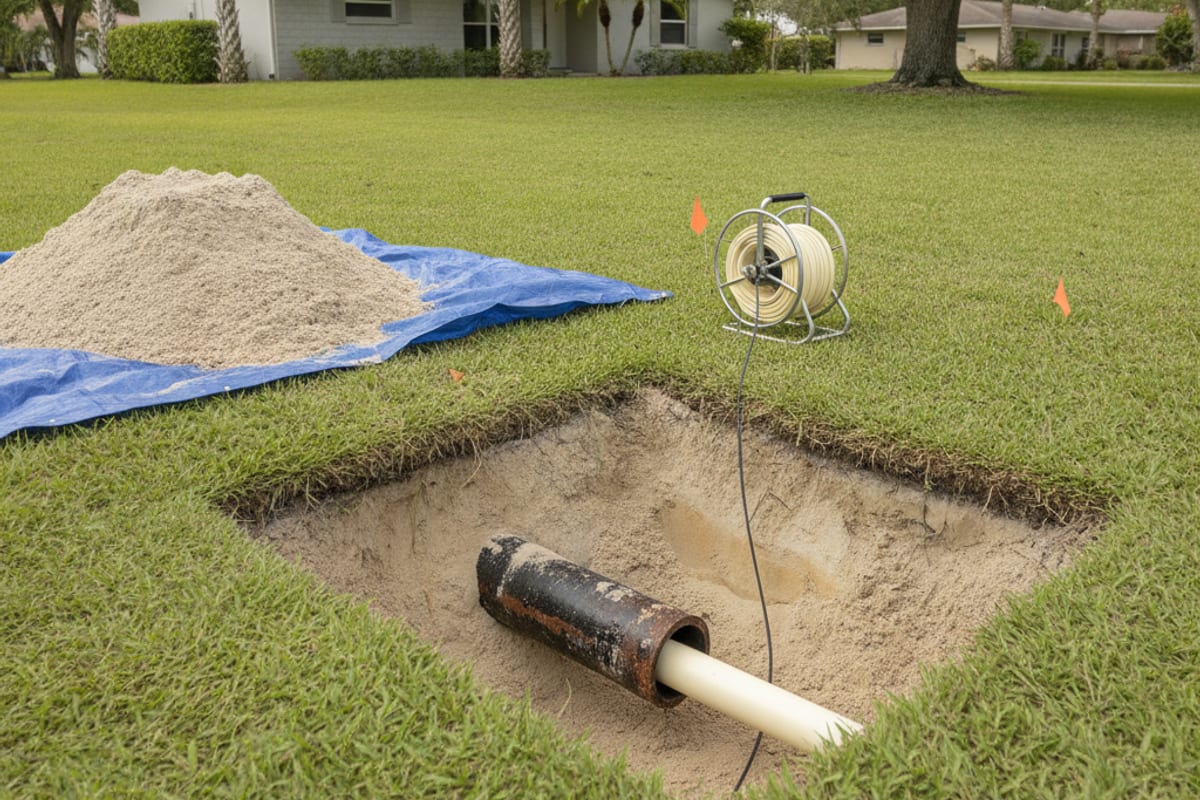
Both work through small pits at each end instead of a trench along the whole run. That is the entire selling point, and in an established neighborhood where the lateral crosses a driveway, a patio, or sixty years of live oak roots, it is a real one. Restoring a lawn is cheap. Restoring a paver drive and a mature canopy is not.
One caution about the source above, because it matters. EPA 832-F-99-032, “Trenchless Sewer Rehabilitation”, published September 1999, is written for municipal collection systems, the mains under the street, not for the private lateral running from your house to the property line. We cite it because its method descriptions and its limitations table are the clearest public, non-vendor account of how these techniques behave. The physics carries over to a 4-inch house lateral. The project scale does not.
What rules a line out
This is the part the service pages skip, and it is the part that decides your week.
The EPA fact sheet publishes a limitations table by method. For CIPP, verbatim: “Bypass or diversion of flow required,” “Curing can be difficult for long pipe segments,” “Must allow adequate curing time,” “Defective installation may be difficult to rectify,” “Resin may clump together on bottom of pipe,” and “Reduces pipe diameter.” For pipe bursting: “Bypass or diversion of flow required,” “Insertion pit required,” “Percussive action can cause significant ground movement,” and “May not be suitable for all materials.”
Read those as a qualification checklist, because that is how a camera operator reads them.
A lost grade kills lining. A belly, meaning a sagging section where the pipe has dropped below its intended slope, holds standing water. A liner cured inside a belly is a smooth new pipe with the same sag. The EPA is explicit about the general principle: “If there are major changes in cross section between manholes or if the existing alignment, slope, or pipe bedding material must be changed, each line must be rehabilitated as an independent segment, necessitating even more digging.” If the problem is the geometry, lining preserves the problem.
A collapse kills lining. A liner needs a host pipe to inflate against. Where a clay joint has dropped out or cast iron has rotted through into open soil, there is nothing to line. That is bursting or open-cut territory.
Severe offsets and heavy scale narrow the odds. The liner follows the inside of what is there. A badly offset joint and a heavily tuberculated cast iron wall both mean less usable diameter before you start, and the EPA notes that CIPP “reduces pipe diameter” on top of that. On a 4-inch lateral there is not much margin to give away.
Bedding is a Tampa Bay problem specifically. Pipe bursting works by shoving the old pipe outward into the surrounding soil, which is why the fact sheet warns that “percussive action can cause significant ground movement” and that dynamic bursting heads “can cause movement of the surrounding soils-resulting in additional pressure and ground settlement.” The agency says static heads “are preferred where pipe and soil conditions permit.” Sandy soil and a shallow water table are the normal condition here, not the exception. Where a lateral runs tight along a slab edge or close to a neighboring foundation, that ground movement is a real question to ask out loud before the rig shows up.
Access matters. Both methods need pits. No cleanout and a long run under hardscape can mean more digging than the brochure implies. If your line has no access point at all, adding a cleanout is often step one regardless of which repair follows.
The camera comes first, always
There is no honest way to quote trenchless from symptoms. Backups, gurgling, and a wet patch in the yard narrow it down; they do not tell anyone whether the pipe can hold a liner.
A camera run gives the three facts that decide the method: where the damage is, how long it runs, and whether the line still holds its grade. Our signs you need sewer line repair page covers what sends people looking, and sewer drain repair in Tampa walks through what the footage distinguishes between a clog, a break, and a failed run. A camera or scope inspection on this site runs $150 to $500, varying by whether it is bought standalone or bundled into other work.
Anyone who quotes a trenchless job before the camera has been down the line is quoting a guess, and the correction arrives after the pits are open.
In older housing stock the camera usually finds a material story. Cast iron in St. Petersburg and clay in the pre-war parts of Tampa both fail in patterns, and sewer line problems in older Tampa neighborhoods covers what those patterns look like on screen.
Cost, responsibility, and the Pinellas rebate
On this site, a targeted trenchless repair on one damaged section runs $2,500 to $6,000, and a full sewer line replacement runs $6,000 to $15,000. The full breakdown of what pushes a job through that band lives on sewer line replacement cost in Tampa. Trenchless often costs more per foot of pipe and less in total once restoration is counted, which is why the comparison only resolves on a specific property.
Know where your responsibility stops. The City of Tampa’s Wastewater Collection Division states that “The City maintains the sanitary sewer system from your property line toward the street, easement or alley where the main sewer line is located.” The side of that boundary your damage sits on changes who is paying.
In Pinellas County there is money on the table, and lining is named in it. The county’s Private Sewer Lateral Rebate Program says Pinellas County Utilities “is offering one-time rebates to eligible property owners of single-family homes for the cost of inspecting, repairing, replacing or rehabilitating (lining) their private sewer lateral (PSL).” Eligible customers “can receive 100% up to $350 of the inspection cost,” and for “a repair, full PSL replacement or rehabilitation rebate can receive 50% up to $3,500 of the cost.” The county’s own conditions: the customer “hires a Pinellas County Construction Licensing Board (PCCLB) certified or registered plumber,” the application goes in “within 90 days of work being completed,” and “rebates are limited and will be distributed on a first come, first served basis until funds run out.” The published scope is the lateral itself. Confirm your specific job with the county before you budget that money against it, and verify any plumber at Florida’s license search.
Frequently asked questions
What are the disadvantages of trenchless pipe lining?
The EPA’s limitations list for CIPP is the honest version: flow has to be bypassed, curing takes time and is harder on long segments, a defective installation “may be difficult to rectify,” resin “may clump together on bottom of pipe,” and the method “reduces pipe diameter.” Add the ones the pipe itself imposes. A belly, a collapse, or a severe offset means lining either cannot happen or preserves the defect you were paying to remove.
How long does trenchless sewer repair last?
We will not publish a lifespan number, because no source we can verify gives one for a residential lateral in this soil. What we can say is what drives it: the quality of the host pipe at the time of lining, whether the grade was correct going in, how cleanly the laterals and joints were reinstated, and whether roots still have a way in. A liner cured into a sound, correctly sloped host pipe is a different asset than one cured into a compromised one, and the camera footage is the only thing that tells you which you bought.
Is trenchless sewer repair worth it in Tampa?
It usually wins where restoration is expensive and loses where it is cheap. A lateral crossing a paver driveway, a screened lanai, a mature oak, or a slab is the strong case. A short, shallow run under open lawn often costs less open-cut once everything is totaled. The method should be the conclusion of the diagnosis, not the opening offer.
Can a collapsed sewer line be relined?
No. Lining builds a new pipe against the wall of the old one, so it needs a host pipe that is still there and still roughly round. A collapsed section has no wall to cure against. That is a pipe bursting or open-cut conversation, and the camera shows the difference clearly.
Does trenchless mean no digging at all?
No. Both lining and bursting need access pits, and the EPA lists “insertion pit required” among pipe bursting’s limitations outright. Trenchless means small, targeted excavation at the ends instead of a trench along the full length. Where a line has no cleanout, or where it changes direction, expect more.
When to call us
Call when the main keeps backing up, when a camera has already found damage and someone has quoted you a method, or when you want the footage before you commit to a number. The licensed plumbers we send run the camera first, tell you whether the line can actually hold a liner, and price the method that the pipe supports rather than the one that sells easiest. Our sewer line repair page covers the full scope. Call us at (813) 590-0625.