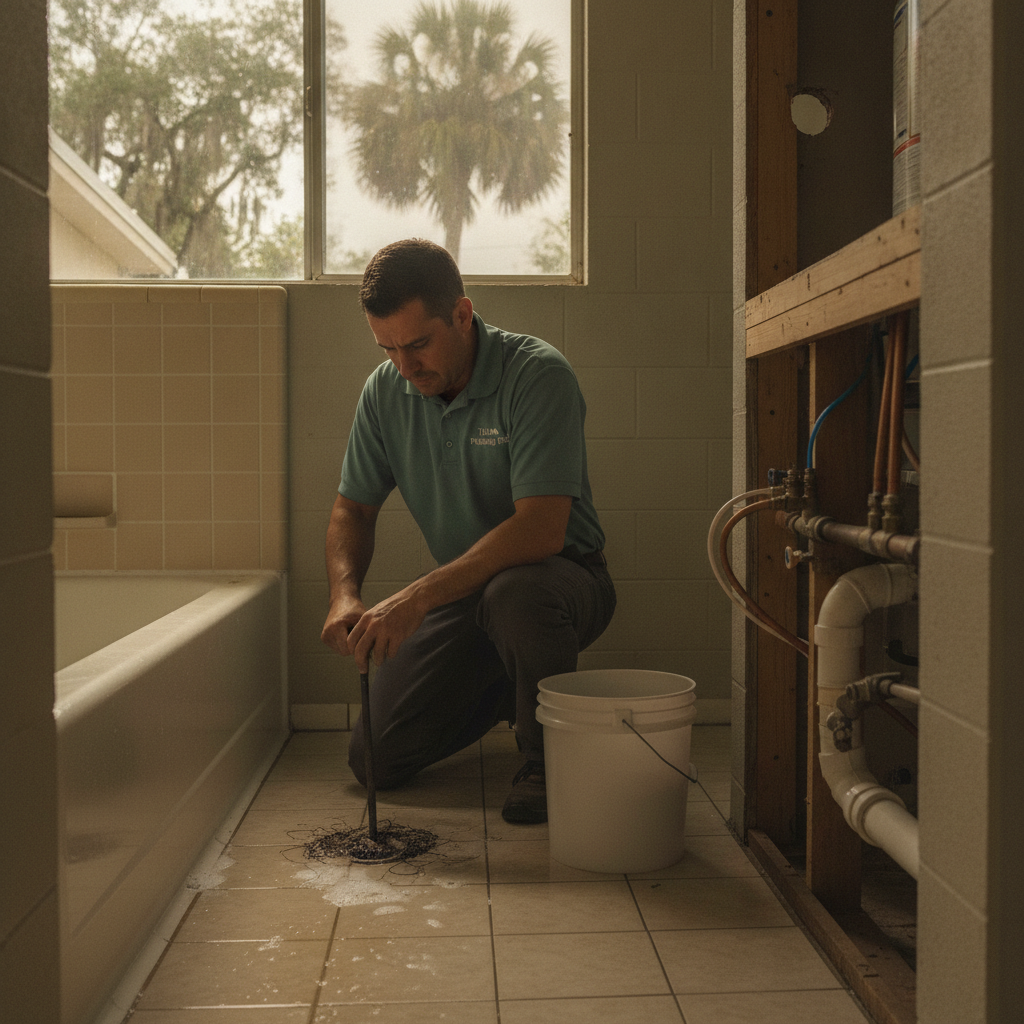
Water sitting around your calves after a Hyde Park shower is a bathtub not draining, and it is almost never one mystery blob in the middle of the house. Hair and soap scum catch first in the drain shoe under the stopper. If that path is clear, the overflow channel or a line further toward the stack is holding the rest.
Overflow vs the shoe vs the line
A tub has three places water can stall, and they fail in a predictable order. The drain shoe is the short fitting under the grate. The overflow is the wall opening, tied into that same fitting by a hidden pipe. Downstream of both sit the trap and the branch that joins the rest of the bath.
A bath that takes forever to fill is a supply problem. That can be a scaled valve or a water heater that cannot keep up. A bathtub not draining is the opposite. The water got in. It will not leave.
Tampa Bay water runs 11 to 17 grains of hardness, so soap does not rinse clean. It leaves a sticky film. Hair binds to that film and felts into a rope inside the shoe. In a Brandon rental, that crust can slow a tub after a year on city water. In a 1950s St. Petersburg bungalow, rust inside a cast iron shoe narrows the opening even when the grate looks empty.
The overflow fools a plunger. Air leaks in through the plate, so you never build suction. Hair also wraps the trip-lever linkage behind that plate. The grate looks clean. The tub still holds water.
| Where it fails | What you notice | Why it happens |
|---|---|---|
| Drain shoe under the stopper | Water pools at the grate, and the sink and toilet behave. | Hair and soap pack in the first inches of the waste fitting. |
| Overflow channel | A plunger does nothing until you block the overflow. | The overflow is an open air path, and hair collects on the linkage. |
| Trap, branch, or main | The toilet gurgles, or a nearby sink backs up. | The restriction is past the fixture, or a vent cannot let air in. |
East Hillsborough slabs hide the shoe. You cannot crawl under a Valrico ranch and unscrew a trap. Raised bungalows in Seminole Heights sometimes let a plumber reach that fitting from below. Same puddle. Different access.
What a plumber snakes first
The overflow is the designed access for a bathtub. The plumbers we send pull that plate first. On a trip-lever tub, the brass linkage comes out with it, often wearing a wet sleeve of hair. That one pull clears a lot of slow baths. Then they run a cable through that opening because it has a straighter shot at the trap than the grate does.
If the clog is sitting in the shoe, they work from the grate. A lift-and-turn stopper in hard water often will not unscrew. Scale locks the threads. Once the stopper is out, the felt you could not see from above comes with it.
A standard single-fixture drain clearing runs $150 to $350 depending on access and severity. That is the published range for this kind of drain cleaning when the stoppage is still at the tub. Main-line hydro-jetting is a different job, published at $350 to $700, used when grease and sludge sit further down. Snaking and hydro-jetting are not interchangeable on old cast iron. High-pressure water cuts soap and sludge. It is the wrong first move on pipe that has already thinned.
Scoop standing water so a plunger can seal, and cover the overflow with a wet rag. Use a cup-style plunger on the grate. Pull the stopper if it lifts freely, and put the hair in the trash, not the toilet. Hot tap water can soften a light soap film. Boiling water warps acrylic. Baking soda and vinegar fizz. They do not cut a packed hair rope. Caustic liquid cleaners sit on standing water and etch enamel.
Clearing a stoppage sits inside the Florida Building Code’s plumbing repair exemption when the work does not replace or rearrange pipes or fixtures. Replacing the waste-and-overflow assembly is what leaves that exemption, and the permit question then goes to your local building department. A mesh hair catcher you empty after each shower beats a monthly potion, which is the same habit behind keeping Florida drains clear. On Gulf-beach baths, salt air seizes overflow screws. Brass holds up better than plated steel.
When a bathtub not draining points to the vent or sewer
When the tub, the toilet, and the bath sink all slow together, the clog is past the fixture. Water leaving the tub has to push air out of the line. If a vent is blocked or the branch is packed, the toilet bubbles and the tub falls in surges. That is the same pattern as a toilet that gurgles when the shower runs.
Inside City of Tampa service, many homes have two cleanouts: one near the foundation and one at or near the property line. If the cleanout next to the house has no water in it, the blockage is in the house plumbing. If the property-line cleanout holds water, the problem is likely in the City sewer line, per Tampa’s Wastewater Department. Wastewater Collection Division personnel are not permitted to work on private property between the right-of-way and the house. Pinellas, Pasco, and unincorporated Hillsborough run their own systems, so read the utility name on the bill before you apply Tampa’s test on a Dunedin or Land O’ Lakes lot.
A camera inspection, standalone or bundled, runs $150 to $500. The camera is how you learn whether a Seminole Heights or St. Pete bungalow is looking at hair or cast iron failing from the inside. Once the pipe is collapsing, another cable is a stall. That is when the plumbers we send talk about a drain replacement, and a whole-home repipe if the galvanized supply is going at the same time.
Pasco and rural Hillsborough add septic. Land O’ Lakes, Odessa, Thonotosassa, and Wimauma still sit on tanks, and sandy soil with a high water table lets a field that was fine in March back up in August. If the tub and the toilet both refuse after a long storm, that is not hair in the shoe. We’ll get a licensed and registered septic contractor out. The state onsite-sewage program sits with DEP. Do not open a tank while the yard is still saturated. Confirm a plumber’s license at Florida’s DBPR search before anyone opens a cleanout.
Common questions
These are the questions that show up once the grate looks fine and the tub still will not drop.
How do you unclog a bathtub with standing water?
Scoop enough water out that a plunger can sit flat on the grate, then cover the overflow with a wet rag so you can actually build suction. If the water does not start to fall after a short run of plunging, stop. Standing water is often a packed shoe or a clog past the trap, and more pumping just moves debris further into the line. That is the moment for a licensed plumber and a cable through the overflow, not another bottle of cleaner. Leave the tub unused until it empties. Water sitting against the overflow plate will spill onto the floor before it finds a blocked shoe.
Why does a bathtub drain slowly when the grate looks clear?
The restriction is rarely sitting on the grate. It is in the overflow linkage, the shoe under the tub, the trap, or a shared line further down. Hard-water soap film binds hair in those hidden fittings. In pre-1975 Tampa and St. Pete housing, rust inside cast iron narrows the same path. If other fixtures in that bath slow at the same time, treat it as a branch or main issue and look at drain cleaning cost and scope before you keep working from the tub alone.
Why won’t the bathtub stopper come out?
Lift-and-turn and trip-lever stoppers seize. Hard water leaves scale on the threads, and the overflow linkage rusts behind the plate. Forcing it with pliers chews the finish and can snap the linkage inside the overflow pipe. The plumbers we send take the overflow plate off, back the stopper out from a position they can see, and clear the hair that locked it. A stuck stopper is often the clog, not a separate mystery.
When to call us
Call when the tub still holds water after you have pulled the hair you can reach, when the toilet gurgles as the bath empties, or when more than one fixture in that bathroom is slow. The plumbers we send are licensed and insured, and they will snake the overflow, camera the line if the cable does not restore flow, and line you up with a licensed and registered septic contractor when the backup is on a Pasco or rural Hillsborough tank. Call us at (813) 590-0625.