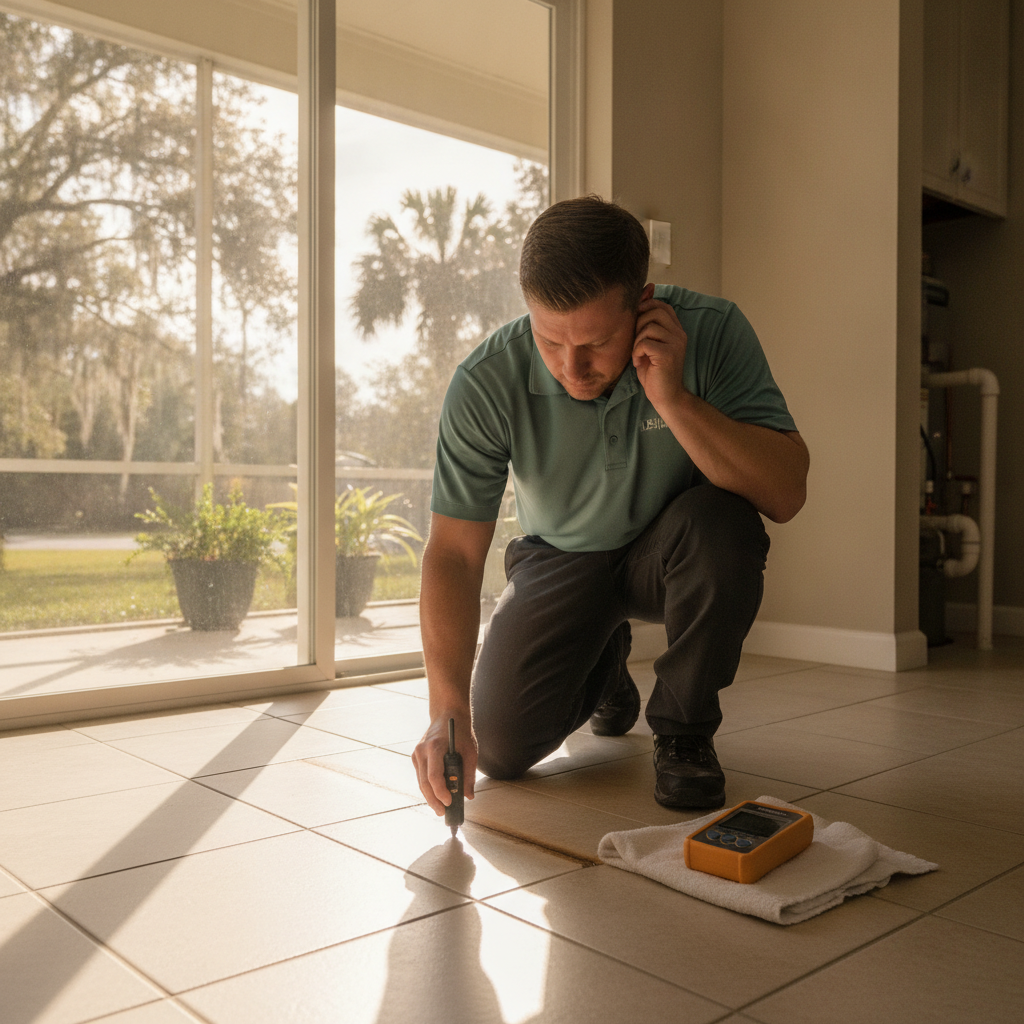
The meter at a Brandon ranch keeps ticking with every tap shut. A Seminole Heights hallway stain keeps spreading even though the roof was just redone. That is leak detection in Tampa: a licensed plumber isolating hidden water loss in supply lines, under slabs, and inside walls before anyone opens a floor.
What leak detection in Tampa actually finds
Leak detection Tampa is a finding job, not a repair. The plumbers we send are hunting pressurized water that is leaving the system somewhere you cannot see. A dripping hose bib on the lanai is not the puzzle. The puzzle is the line that never shows a puddle because the sand under an East Hillsborough slab drinks it, or the copper run inside a Hyde Park wall that only weeps when the water heater cycles.
Supply leaks are the ones that move the meter. Drain leaks back up, smell, or stain a ceiling under a bathroom. They do not spin the city meter while the house is idle. That split matters, because the first useful test is almost always at the meter, not in the drywall.
The housing stock tells you what you are likely to find. Central Tampa and Seminole Heights still carry galvanized supply that corrodes from the inside out. Once one joint weeps, the next one is usually not far behind. St. Pete bungalows and Gulf-beach cottages add salt air on every exposed fitting, plus old cast iron on the drain side that can look like a supply stain until someone isolates the two. East Hillsborough, Brandon, Valrico, Seffner, and FishHawk sit on slab-on-grade from the 1980s into the 2000s, which is also the polybutylene belt. A 1990s copper home in Lutz or Carrollwood is in the age range where pitting and pinhole leaks become more common. One pinhole does not always mean the whole house is finished. A second one, or visible pitting at an exposed joint, is a different conversation.
Pasco and rural Hillsborough add well systems. The leak can sit between the well and the house, or in the same indoor copper and PEX everyone else has. The finding sequence still starts with isolation. It just starts at a different shutoff.
What the test is not: a roof inspection, a mold survey, or a promise that the first wet spot is the hole. Water travels. A stain on a hallway ceiling can be a supply nick two rooms over. The point of professional leak detection is to name the pipe, the zone, and the access path before anyone cuts tile.
Meter, acoustic, and slab tests on a Tampa Bay house
A licensed plumber isolates a hidden supply leak in layers. The cheap, quiet tests come first. Opening a floor comes last, and only after the leak has a location.
| Method | What it tells you | When it fits a Tampa Bay house |
|---|---|---|
| Meter isolation | Water is still leaving the system with every fixture off | First pass on city water in Hillsborough, Pinellas, or Pasco |
| House-valve split | The leak is inside the dwelling or on the yard side of the shutoff | After the meter moves, before anyone looks under a slab |
| Acoustic listening | Where pressurized water is escaping behind a wall or under concrete | Warm floors, a hiss you cannot place, Brandon slab leak detection |
| Zone pressure checks | Which branch or fixture run is dropping | After the meter confirms a leak and before tile comes up |
Hillsborough County tells its customers to read the meter, wait two hours with no water in the home or on the lawn, and read it again. The two readings should be identical. Pasco County adds the house-valve split: if the meter still moves after the valve at the house is closed, the issue is likely outside the dwelling. If the meter stops, the leak is somewhere in the indoor plumbing. The EPA’s Fix a Leak Week guidance makes the same point. A meter that moves during a no-use period may indicate a leak. It does not tell you which pipe.
A toilet can fool the meter all by itself. Hillsborough’s own leak tips say to add a few drops of food coloring to the tank and wait about 15 minutes. Color in the bowl means the flapper is passing water. That is a fixture leak, and it is not under the slab. The same page flags a water softener stuck on backflush, which will keep using water as part of a failed cycle. Those two checks save a lot of slab talk on a Tuesday afternoon.
Once the meter says there is a real supply leak, the plumber we send starts isolating. Outdoor hose bibs get shut. Irrigation gets parked. The main is used to split yard line from house line. Inside, fixture stops and branch valves narrow it to a bathroom group, a kitchen run, or the water heater. Only then does acoustic gear come out: a listening device on the slab, along a baseboard, or on an exposed copper stub. Pressurized water escaping through a pinhole makes a hiss the ear cannot place and the pickup can.
Slab leak detection is the under-concrete version of that last step, and that page owns the slab test itself. The whole-house job is the sequence around it. Moisture readings on grout and drywall map the wet path so the cut, if a cut is needed, lands on the leak instead of two feet beside it.
None of this requires a jackhammer on the first visit. Demolition is a last resort after isolation has failed to name a spot, not a detection method.
High bills, warm floors, and stains that are not the roof
A high water bill that does not match how the house has been used is the most common reason people call. City of Tampa Water notes that a faucet dripping one small drop per second can waste 7 gallons per day, or more than 2,500 gallons per year. A hidden supply leak under a slab or in a wall does that quietly, for weeks. The bill is the symptom. The meter test is the confirmation. The listening work is the location.
Warm floors are the slab tell in this metro. A hot line under a Brandon or Valrico ranch heats a stripe of tile that has no business being warm in October. You feel it in bare feet on the way to the kitchen. The rest of the floor is normal. That stripe is not a roof leak, and it is not the air conditioner. The signs of a slab leak in Florida run in that direction: a warm path, a unexplained bill, a meter that never quite sits still, sometimes a damp grout line that never dries after the afternoon storm.
Ceiling and wall stains need a different split. An upstairs bathroom over a Seminole Heights hallway can drip from a supply, a drain, or a tub overflow. A roof leak after a Gulf storm can mimic all three. The plumber we send does not guess from the stain color. Isolation does the sorting. If the meter is quiet and the stain still grows when it rains, that is not a supply leak. If the meter runs on a clear Tuesday with the irrigation off, the roof is not the story.
Mold on a wall can follow a hidden wet path. It can also follow a slow AC leak or a bathroom that never gets a fan. The EPA’s moisture guidance is to dry water-damaged areas and items within 24 to 48 hours to help prevent mold growth. That is a prevention window, not a clock for when mold must appear. Finding the water is still the plumbing job.
Hurricane season, June through November, is when a lot of these calls stack up. Storms soak the sand under South Shore slabs in Apollo Beach and Ruskin, so a small under-slab weep that had been draining away suddenly has nowhere to go. You see it as a damp spot that was never there in March. The leak was often already running. The water table just stopped hiding it.
When detection turns into a repair or a repipe
Finding the leak is step one. What you do next depends on the pipe, not the puddle.
A single copper pinhole on an otherwise sound run can be a targeted repair. Recurring pinholes in more than one spot, or visible corrosion at exposed joints, is when a whole-home repipe becomes the longer-term move. Galvanized in Hyde Park, Seminole Heights, and older South Tampa fails in clusters. Patching one leak usually means the next one is a few months out. Polybutylene in a late-1970s-to-mid-1990s Valrico or Brandon subdivision is the same kind of system decision: the fitting in your hand is not the only fitting in the slab.
Under the concrete, the plumbers we send shift from detection to slab leak repair once the spot is named. Access, pipe material, and whether the rest of the run is already pitted are what move the scope. A longer run of sewer or supply under a slab means more concrete to open and close if the repair is a direct bury. A reroute that leaves the failed section abandoned in the slab is a different path. The detection visit is what makes that choice possible without opening three rooms to find one hole.
Florida still treats plumbing as permitted work. The statewide under-$7,500 permit exemption that took effect July 1, 2026, expressly does not cover plumbing on a single-family dwelling. A local building department is who confirms the permit path for the repair that follows the finding. City of Tampa prices a residential plumbing (general) trade permit at $120.00, plus the Florida Building Permit Surcharge of 2.5% of permit value or a $4.00 minimum. Unincorporated Hillsborough County prices residential plumbing (general) at $130.00. Pinellas and Pasco set their own, and those schedules were not the ones in front of us here.
The plumber you send out should be licensed. You can confirm that on Florida’s DBPR licensee search before anyone opens a wall. The plumbers we send are licensed and insured. This brand matches you with them. It does not hold the license or swing the hammer.
How do you check for a water leak in the house?
Shut off every tap, skip the irrigation, and read the meter. Wait two hours with no water use, then read it again. Identical numbers mean the system is holding. A climbing number means water is still leaving. If you have a shutoff at the house, close it and watch the meter a second time. Movement with the house valve closed points to the yard side of that valve. A quiet meter with the valve closed points inside. Dye in the toilet tank for 15 minutes rules out a flapper before anyone talks about a slab.
Does leak detection include the repair?
Detection finds the leak. Repair is a separate job once the pipe and the access path are named. Some visits move straight into a targeted fix when the leak is at a valve, a water heater fitting, or an exposed run. Slab work, a wall opening, or a repipe is scoped after the finding, not guessed from the bill.
When to call us
Call when the meter moves with everything off, a floor is warm in a stripe, or a stain keeps spreading with no roof story to match it. The plumbers we send isolate the leak before anyone opens a floor, then line up the repair or the repipe the house actually needs. Call us at (813) 590-0625.