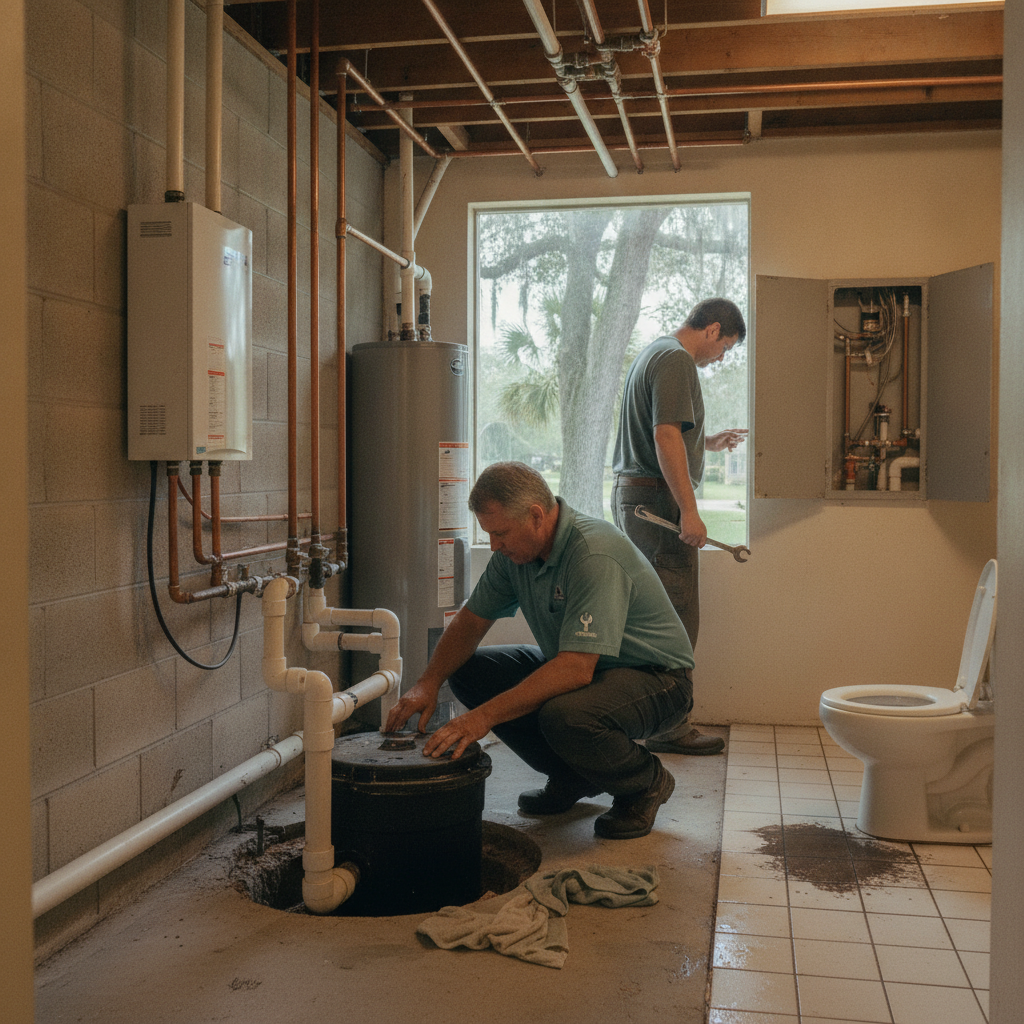
The downstairs toilet in a South Tampa split-level does not drain by gravity. Waste from that bath, a sunken den, or a garage conversion sits below the street sewer, so a sealed basin and a sewage pump have to lift it. When the basin fills and those fixtures gurgle or overflow, you need ejector pump repair, not another bottle of cleaner. Tampa Bay has few true basements because of the high water table and slab-on-grade construction, but the same pump shows up under added baths in Hyde Park, Town ‘n’ Country, and older St. Petersburg bungalows.
Ejector vs grinder vs sump
Three different machines get called the pump in the pit. Mixing them up sends the wrong parts to a sewage job.
A sump pump moves groundwater and storm water. It sits in an open or loosely covered crock and dumps relatively clear water toward a yard line or storm drain. After an August downpour in Apollo Beach or Ruskin, that is the pump that keeps a low slab dry. It is not built to pass toilet paper and solids.
A sewage ejector pump is the downstairs-bath machine. Fixtures below the building sewer empty into a sealed basin. A float rises, the motor starts, and an impeller lifts the wastewater up a discharge pipe, through a check valve, into the gravity sewer. The lid has to stay airtight because the basin holds sewage. A roof vent keeps the pit from pulling air through nearby traps when the pump runs.
A grinder pump is the cousin on a low-pressure sewer. It shreds solids before it pumps, which is how those systems move waste through a small force main. Pinellas County Utilities describes low-pressure sewer as individual grinder stations at each home, used where the water table is high and deep gravity mains would be costly. Hillsborough County built many of those systems in the 1980s in Gibsonton, Palm River, Ruskin, and Wimauma, and the county now calls them unreliable. If your alarm panel sits outside and the house rides a skinny force main, you are in grinder territory. That job is covered in our grinder pump repair guide.
| Pump | What it moves | Where you find it in Tampa Bay | Pit and lid |
|---|---|---|---|
| Sump | Groundwater and storm water | Low slabs on the South Shore, crawl spaces, and yards that pond in summer storms | Open or loosely covered crock, not a sewage seal |
| Ejector | Wastewater and solids from fixtures below the sewer | Downstairs baths, sunken dens, garage conversions in South Tampa, Town ‘n’ Country, and older Pinellas stock | Sealed basin, gasketed lid, roof vent, check valve on the discharge |
| Grinder | Shredded sewage into a low-pressure force main | Hillsborough LPSS neighborhoods and some Pinellas conversions | Outdoor or buried station with a control panel, not a bathroom basin |
Pasco and rural Hillsborough add one more twist. A Land O’ Lakes or Thonotosassa house on a septic tank can still have an ejector if a bath was added below the tank inlet. The pump is ordinary plumbing. Opening, pumping, or repairing the tank itself is onsite sewage work, and that belongs to a licensed and registered septic contractor.
Alarm, backup, and a failed float
A healthy ejector sits quiet until someone flushes or a downstairs shower runs. Then you hear a short run, a click at the check valve, and silence. Trouble has a different soundtrack.
A high-water alarm is the honest one. The backup float in the basin has risen past the pump’s normal on-point, which means the pump did not keep up. Stop using the downstairs toilet, shower, and laundry. Every extra gallon has nowhere to go but the floor.
A failed or tangled float is the most common mechanical miss. Hair, wipes, and laundry lint wrap the switch until it cannot rise, so the motor never gets the start signal. The basin fills, traps gurgle, and the downstairs toilet looks clogged even though the bowl itself is fine. The opposite failure sticks the float up, so the pump runs dry and overheats.
Short cycling is usually the check valve, not the motor. Waste goes up the discharge, the pump shuts off, and a worn flapper lets that column fall back into the pit. The float rises again within seconds. The motor works itself to death on a few gallons that never leave the house.
A humming pump that moves no water is often a jammed impeller. Flushable wipes, dental floss, and too much paper wedge the impeller in an ejector the same way they wedge a drain. A silent pump with a tripped breaker is the same jam one step later: the motor drew too much current and the thermal overload or the panel opened. Leave the electrical panel alone and let a licensed plumber pull the unit.
Gurgling in the downstairs lavatory when the utility sink runs is often the pit vent, not the fixture trap. The pump creates a pressure swing. If the vent is blocked or the lid gasket has failed, that swing pulls air through the nearest P-trap and can push sewer smell in the house into a finished room. Damp concrete around the basin is the same leak in slow motion: a hairline crack in the discharge, a failed grommet, or a lid that is no longer airtight.
Sometimes the pump is fine and the pipe is not. If the discharge or the house sewer is restricted, the ejector pushes against a wall of grease, scale, or roots until the motor cooks. That is a drain cleaning job first, often with a camera so the plumber can see whether the line is clear enough to keep pumping. A downstairs laundry makes this worse. A washing machine can dump a fast slug of water into the basin, and a leaking tank in the same closet can keep the pit in a constant cycle. If the water on the floor is clean and hot, look at water heater repair before you condemn the pump.
Hurricane season adds a second flood path. Groundwater belongs to the sump. Sewage belongs to the ejector. Citizens Property Insurance’s HO-3 Coverage Worksheet lists water backup of sewers and drains or sump overflow as not covered, with no option to add it on that form, so a downstairs sewage overflow is a plumbing problem and an insurance reading at once. Details live on our sewer backup insurance page. Where downstairs fixtures sit below the next upstream manhole, Florida’s plumbing code calls for a backwater valve so city-main surcharge cannot push into the house. Installed, that valve typically runs $600 to $1,500 depending on access to the line. Storm surge on the South Shore is a National Weather Service Tampa Bay forecast. The ejector still only moves what the downstairs fixtures put into it.
Ejector pump repair versus a full replacement
A float, a check valve, or a lid gasket is often the whole repair. The basin, the discharge, and the motor stay. Replacement enters when the motor is burned, the impeller is worn down to sludge, the basin is cracked, or the pump was never sized for a toilet plus a shower plus a washer on the same pit.
What moves the number is access and what else has to come out with the pump. A basin buried under a finished Hyde Park bath costs more labor than an open pit in a Town ‘n’ Country garage. A cracked basin means a new tank, new lid, and new grommets, not just a drop-in motor. Discharge piping that has narrowed with grease or scale needs clearing or a section replaced, or the new pump will fight the same clog. Older South Tampa and St. Petersburg houses still run cast iron building drains into that pit. Once that iron is egg-shaped and thin, a whole-home repipe conversation is honest, because patching the pump and leaving a collapsing drain just schedules the next backup. None of that is a published ejector-pump price on this site. The plumber who opens the pit quotes after seeing the basin, the wiring, and the discharge.
A camera inspection on the line out of the pit, bought on its own or bundled with other work, runs $150 to $500 on this site, varying with whether it rides along with cleaning or stands alone. Fixture clearing is $150 to $350. Main-line jetting is $350 to $700. Those figures are for the drain side. They are not a stand-in for the pump.
Repair of a leaking valve or pipe can sit inside Florida’s building-code exemption for clearing stoppages and repairing leaks, so long as the job does not replace or rearrange valves, pipes, or fixtures. Swapping the pump, the basin, or the discharge takes the work back out of that exemption, and the permit question then goes to the local building department. Florida’s 2026 under-$7,500 permit exemption also carves out plumbing on a single-family dwelling, so that headline never covered this job. Inside Tampa city limits, a residential plumbing (general) trade permit is $120.00 plus the Florida Building Permit Surcharge of 2.5% of permit value or a $4.00 minimum. Unincorporated Hillsborough lists residential plumbing (general) at $130.00. Those are the permit lines, not the cost of the pump, and Pinellas and Pasco set their own.
Confirm the plumber is licensed through Florida’s licensee search before anyone opens a sewage basin. How to read that listing is in choosing a licensed plumber in Tampa.
Common questions about downstairs sewage pumps
How much does it cost to replace a sewage ejector pump in Tampa Bay?
There is no published Tampa Bay price for the pump itself on this site, so a quote after the pit is opened is the honest number. What you can budget around is everything attached to it. A clogged discharge is drain work at the ranges above. A camera pass to see the line is $150 to $500. A cracked basin, a buried pit under a finished floor, or a discharge that has to be rerouted all push labor up because of access and concrete, not because the motor is exotic. Ask the plumber to separate the pump, the basin, the check valve, and any line cleaning so you can see which piece is actually failed.
How is a sewage ejector pit sealed?
The basin is a sewage tank, so the lid bolts down on a gasket, the discharge and the vent pass through tight grommets, and the vent continues to the roof. That seal keeps sewer gas out of a finished downstairs room and keeps the pump from sucking air through nearby traps. Foam, tape, or a loose decorative cover will not hold. A missing or rotten gasket, a cracked lid, or a vent that terminates in the room is why the area around the pit smells or stays damp even when the floor looks dry. Sealing that system is licensed plumbing. Leave the lid closed until the plumber arrives, and keep people and pets off the wet area.
When to call us
Call when a downstairs toilet, shower, or laundry backs up, the pit alarm sounds, the pump runs without dropping the water, or sewer gas sits around a sealed basin. The plumbers we send are licensed and insured, and they will open the pit, free or replace the float, and repair or replace the pump once they see what failed. Call us at (813) 590-0625.