We get asked some version of this question almost every week: is a water softener actually worth it, or is it a sales pitch. In most of the country the honest answer is “depends.” In Tampa Bay, the honest answer is usually yes, and the reason is in your water report, not in anything we’re trying to sell you.
The numbers that matter
Water hardness is measured in grains per gallon (gpg). Anything under 3.5 gpg is soft. 3.5 to 7 is moderately hard. 7 to 10.5 is hard. Above 10.5 is very hard. Tampa’s municipal water runs around 11.7 gpg on average, which already puts it solidly in the very hard category, and that number climbs toward 17 to 18 gpg during the dry season when the water supply leans more on groundwater sources. St. Petersburg and Pinellas Park test in a similar range, and homes on private wells in Odessa, Thonotosassa, or rural Pasco can run even higher, often with added iron and sulfur.
For comparison, a lot of the Midwest and Northeast sits in the moderately hard range. Tampa is dealing with meaningfully harder water than most of the country, which is the whole reason this conversation is different here than it is for a plumber in Seattle.
What hard water actually costs you without a softener
Hard water isn’t dangerous to drink, so the case for a softener isn’t a health argument. It’s a wear-and-tear argument, and it adds up in several places at once.
Water heaters scale up faster in hard water, which we cover in detail elsewhere, but the short version is a water heater that should last 10-12 years often needs water heater repair or replacement in 5-7 years in Tampa’s water without mitigation.
Fixtures and faucets develop visible mineral buildup, that white or greenish crusty deposit around aerators and showerheads, faster than in soft water areas, and that buildup restricts flow and eventually turns into a faucet or fixture replacement.
Soap and detergent don’t lather properly in hard water, which means people use more shampoo, more dish soap, and more laundry detergent to get the same result, and still end up with that filmy residue on skin, hair, dishes, and glassware.
Appliances that use water, dishwashers, washing machines, ice makers, accumulate scale internally the same way water heaters do, shortening their working life and reducing efficiency.
Pipes themselves, especially older cast iron or galvanized lines common in St. Pete and Tampa’s pre-1960 neighborhoods, scale up internally over time, narrowing the effective diameter and reducing water pressure throughout the house. If that sounds like what’s happening in your home, a softener slows future buildup, though it won’t undo decades of scale already inside old pipe.
Who benefits most from a softener in this market
If you own a home anywhere in Hillsborough, Pinellas, or Pasco counties on municipal or well water, you’re very likely in hard-to-very-hard territory and would see a real difference. A few situations make the case even stronger. Homes with tankless water heaters need a softener or an aggressive maintenance schedule, because tankless units scale internally faster and are more expensive to repair than tank units. Homes on private well water, common in Odessa, Dade City, and rural Pasco, are typically dealing with hardness on top of iron and sulfur, and a softener paired with iron filtration makes a bigger visible difference than a softener alone. Untreated water on a well also shortens the life of the pump itself, which is worth reading about alongside well pump repair in Tampa Bay. Newer master-planned communities like Wesley Chapel, Riverview, and FishHawk often draw on well sources for irrigation and sometimes household water, and residents there report some of the hardest water readings in the metro.
What a softener actually does
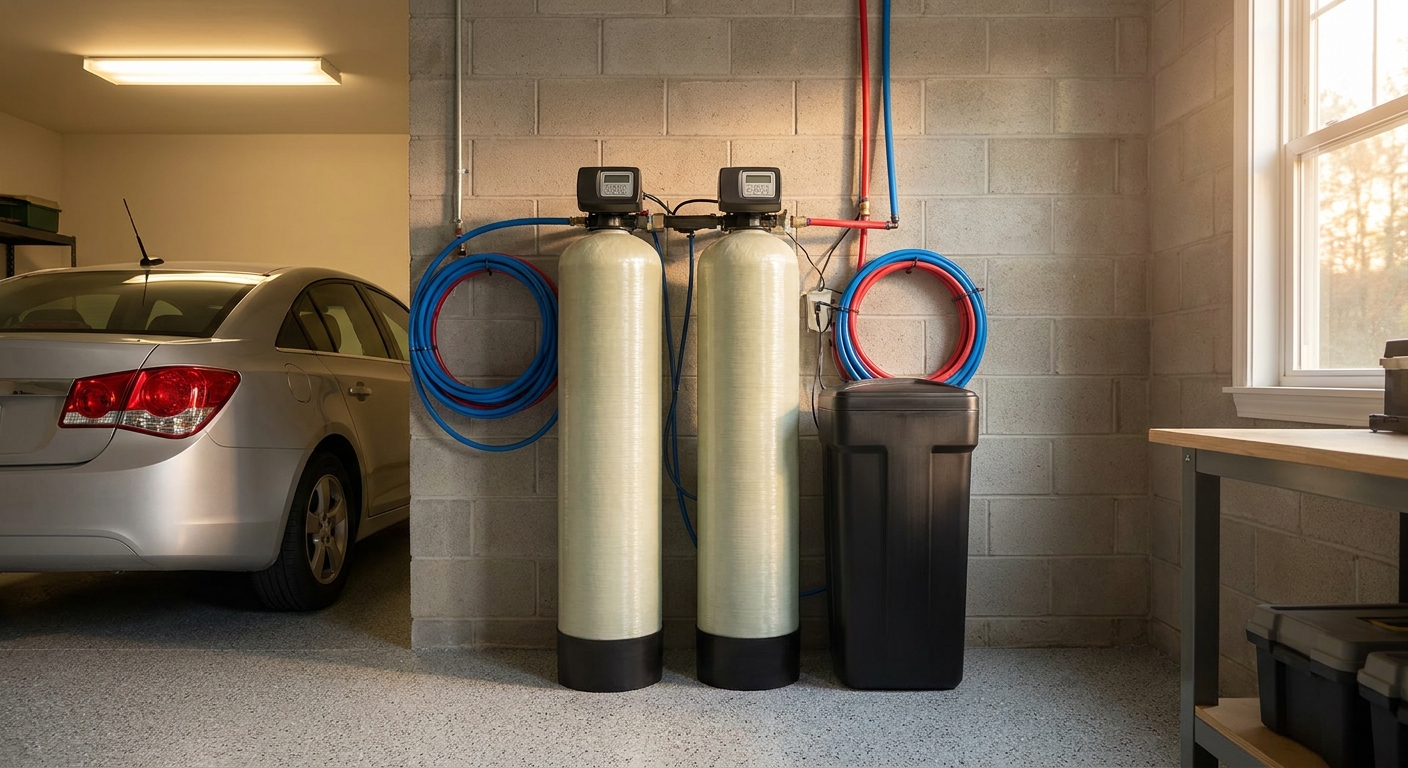
A softener uses a resin bed to swap calcium and magnesium ions for sodium ions before water reaches your fixtures and appliances. The system periodically regenerates, flushing the resin with a brine solution to reset it, which is why softeners need a bag of salt replenished every few weeks to a couple of months depending on household size and water use. Keeping that resin working takes a bit more than topping up salt in this metro, which we cover in water softener maintenance in Tampa Bay.
The result is water that lathers normally, doesn’t leave mineral spots on glassware or fixtures, and doesn’t build scale inside your water heater, pipes, or appliances.
What a softener won’t do is change how your water tastes or smells, since ion exchange doesn’t remove the chloramine Tampa Bay utilities use for disinfection. That’s a separate device, and we compare the two in water filter vs. water softener in a Tampa Bay home.
What it costs installed
For a typical Tampa Bay single-family home, a properly sized whole-house water softener installation runs somewhere between $1,800 and $3,500, depending on the size of the unit, household water usage, and whether you want a salt-based or salt-free system. Larger homes or homes with especially hard well water sometimes need a bigger capacity unit, which runs toward the higher end of that range. Ongoing costs are mostly salt, usually $10-20 a month depending on usage.
Is it worth it
If you’re already replacing a water heater early, cleaning mineral deposits off fixtures constantly, or noticing your dishwasher isn’t getting glasses clean anymore, a softener typically pays for itself over a handful of years just in extended appliance life, on top of the day-to-day difference in water quality. It’s not a mandatory fix the way a slab leak or a failing repipe is, but in Tampa’s water it’s one of the higher-value upgrades a homeowner can make.
Get a real answer for your house
We’ll test your actual water hardness on-site rather than quoting you off the metro average, and give you a straight recommendation on whether a softener makes sense for your specific setup and budget.
Call Tampa Plumbing Pro at (813) 590-0625 and we’ll come take a look.
Salt-based versus salt-free, and why it matters here
Not every softener is the same technology, and in Tampa’s very hard water the distinction actually matters. A traditional salt-based softener uses ion exchange to physically remove calcium and magnesium from the water, replacing them with sodium, and it’s the only technology that truly prevents scale from forming in the first place. Salt-free “conditioners” alter the mineral structure so it’s less likely to stick to surfaces, but they don’t remove the hardness, which means in water as hard as Tampa’s, a lot of homeowners who install a salt-free system are disappointed with how little changes in their water heater’s scaling rate. For genuinely hard water in the 11-18 gpg range we see across this metro, we generally recommend salt-based systems, reserving salt-free options for households specifically trying to avoid added sodium in their water for health reasons.
Sizing it for your household
A softener that’s undersized for your household’s water use will regenerate too often, burning through salt faster and wearing out sooner, while one that’s oversized costs more upfront than necessary. Sizing depends on your actual hardness reading, the number of people in the house, and your daily water usage, which is exactly why we test and calculate rather than sell a single default size to every customer.
Call Tampa Plumbing Pro at (813) 590-0625 and we’ll test your water and spec the right system for your home.